
AI search
What is AEO? Answer engine optimisation for Australian businesses
The quick answer
AEO means answer engine optimisation: making information on your website useful as a direct answer to a customer’s question. It can concern Google’s answer boxes, spoken answers and answers generated by AI search products. For a business owner, the starting point is a clear, accurate answer backed by relevant evidence.
On this page
Key takeaways
- Answer engine optimisation starts with the questions a customer needs resolved before choosing a service.
- SEO, AEO and GEO overlap, so a proposal should name the actual pages and answer formats it covers.
- A short answer should retain the conditions a customer needs to interpret it correctly.
- Being used in an answer is different from receiving a website visit or a suitable enquiry.
What is AEO useful for when you want more suitable enquiries? It helps you focus on the questions people need answered before they choose a business. A clear explanation of your service can help both the person reading your website and a search product looking for a relevant answer.
Our answer engine optimisation work starts with those customer decisions. This guide explains the term and gives you a practical way to improve one existing page.
What is AEO in practice?
AEO is answer engine optimisation. It means improving content so it can provide a direct, accurate answer to a specific question.
Consider an illustrative question for a building firm: “Does your design and build service include planning approval?” A useful response states the firm’s actual role, what is included and where council or outside specialists make decisions. “We handle everything” leaves too much unresolved.
The same principle applies to a comparison, a booking requirement or a price explanation. Answer the question first, then provide enough detail for the reader to act on it.
Does AEO cover answer boxes, voice search and AI answers?
Direct answers appear in different formats. Name the format when you assess a result so a report does not treat unlike observations as equivalent.
| Format | What the customer sees | What the business can inspect |
|---|---|---|
| Google featured snippet | A selected extract displayed prominently as an answer | The wording and source page |
| Google People Also Ask | Related questions with expandable answers | The specific question and attributed source |
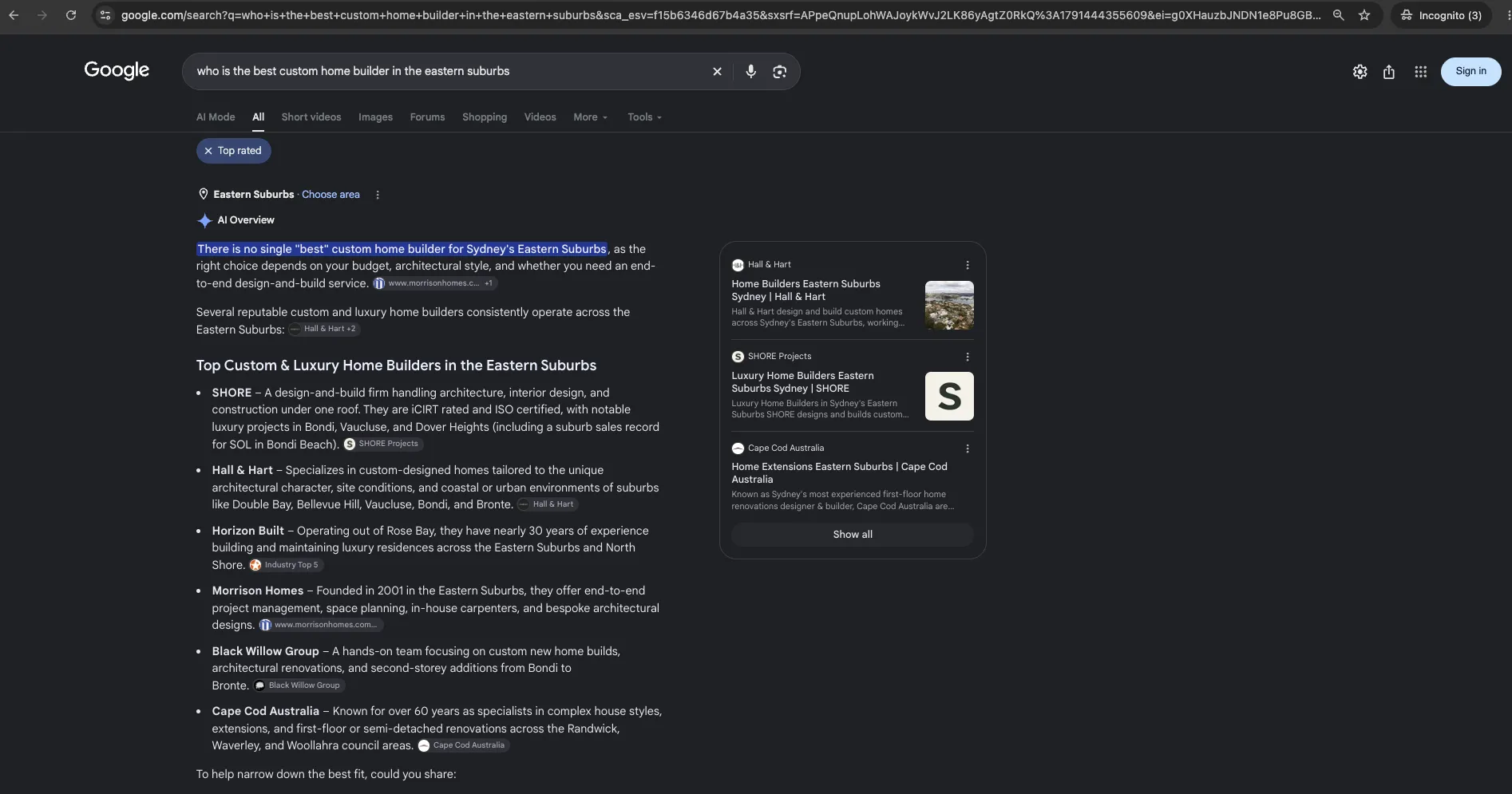
| Google AI Overview | A generated response with supporting sources | The claims, business names and cited pages |
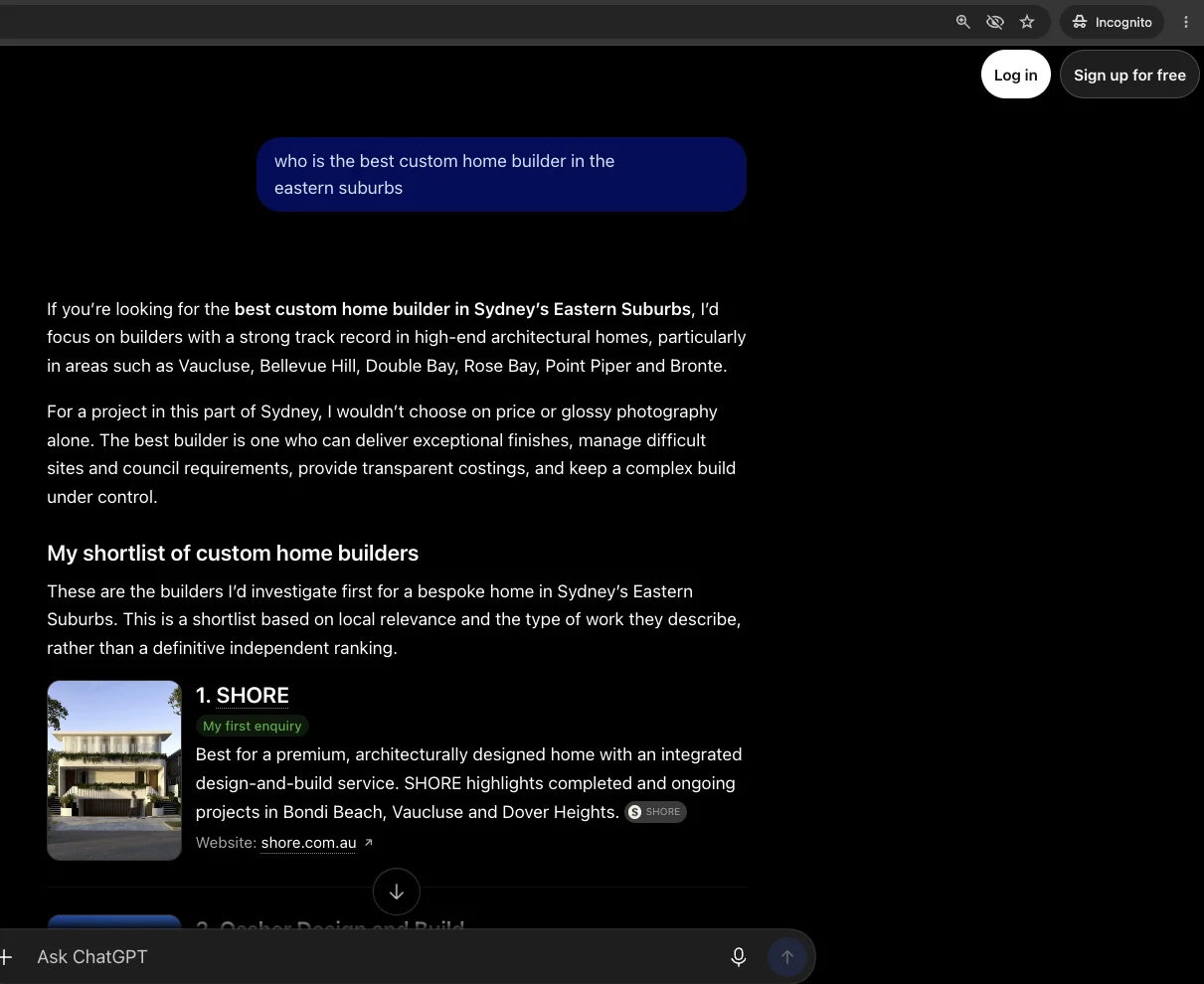
| ChatGPT search | A conversational answer that can include web citations | The complete response and source destinations |
Google calls its selected answer extracts featured snippets and says they can also appear within People Also Ask. Google chooses the extract; there is no page setting that assigns your answer that position.1
ChatGPT search can include links to sources supporting its response.5 Spoken answers are also discussed under AEO. Their sources and formats depend on the particular product. A proposal should identify what will actually be checked.
How is AEO different from SEO and GEO?
The terms describe different areas of focus within overlapping work. You do not need three near-identical pages for three acronyms.
| Term | Main focus | Practical page task |
|---|---|---|
| SEO | Discovery through search | Make the service page useful and easy to find |
| AEO | Resolving a question directly | Explain what is included beside the relevant service |
| GEO | Representation in generated answers | Support claims with material an answer can cite |
GEO stands for generative engine optimisation. Our what is GEO guide covers source citations and the difference between a mention and an enquiry. Google considers work for its generative search experiences part of SEO.2
The business decision is which unanswered question deserves attention. If the answer already exists on a good page, improve that page and its supporting evidence before creating another one.
What can SHORE’s example tell you about AI answers?
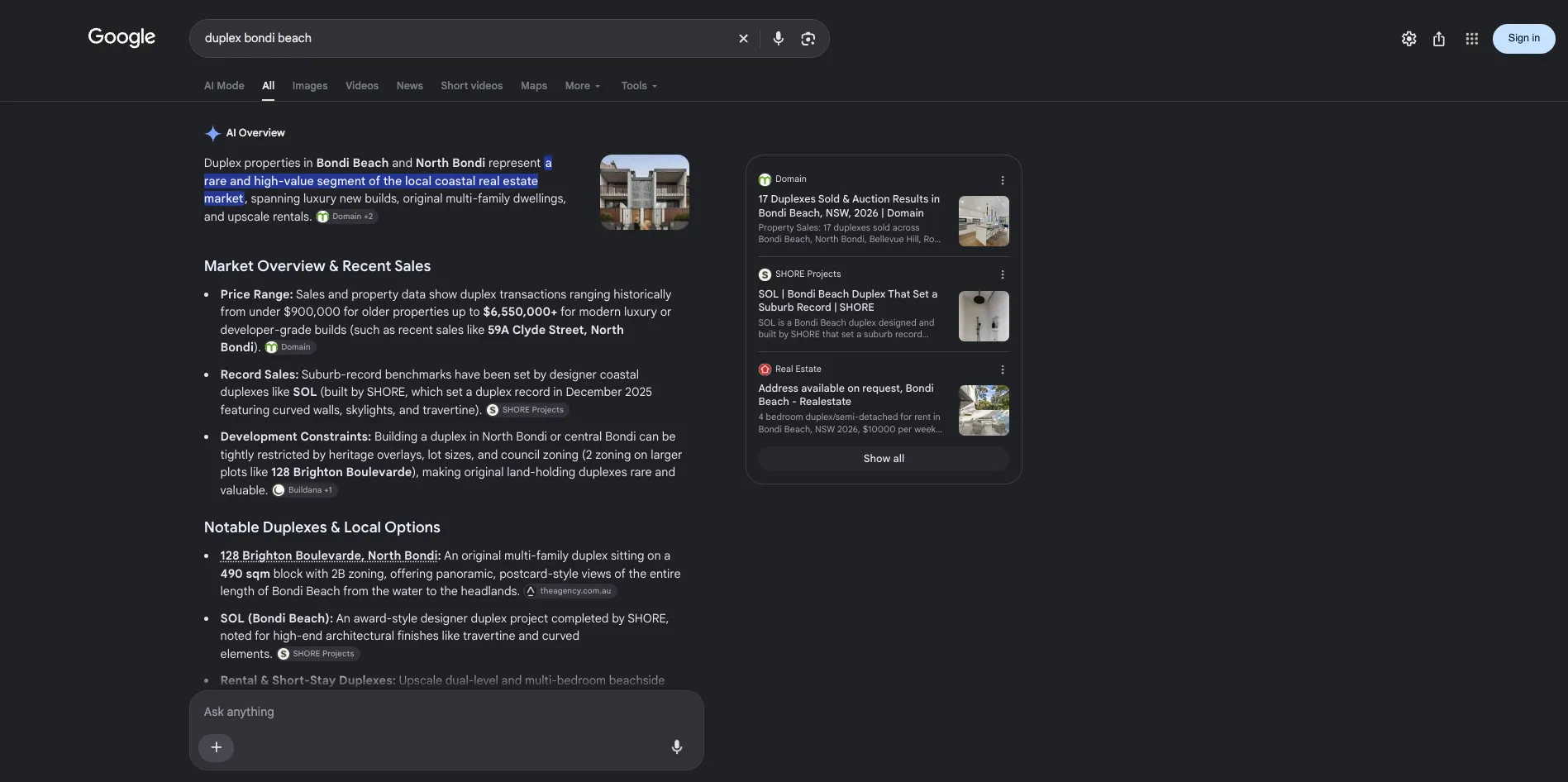
SHORE’s Sydney example shows why a specific answer needs specific supporting work. Google’s AI Overview for “duplex bondi beach” named the SOL duplex and cited SHORE’s project page. The SHORE GEO guide contains the captures and comparison.
Kavera note: We built SHORE’s website and run its SEO. In that example, the source was a page about an actual duplex project. A prospective customer could inspect the work behind the answer.
There is a second observation on another platform. In two checks about two months apart, our client SHORE went from absent to first in one Sydney builder shortlist. The ChatGPT SEO case study shows the question and both answers.
Kavera note: The ChatGPT comparison covers one question on two occasions. It does not measure bookings or prove that a particular heading format caused the change. We use it to show the distinction between an observed answer and a business outcome.
These examples support showing relevant work clearly. They do not establish a separate AEO result for every direct-answer format in the table above.
Which questions should a local service website answer?
Pick a question that affects a customer’s next decision and that your team can answer from experience. Start with the questions you repeatedly resolve before accepting a job.
| Question type | Information the reader needs | Likely home |
|---|---|---|
| Service fit | What you handle and exclude | Service page |
| Location fit | Where you genuinely work | Service page or useful area page |
| Process | Responsibilities and preparation | Process section or detailed guide |
| Cost | Scope, inclusions and price conditions | Pricing or service page |
| Experience | Relevant completed work and your role | Project page |
Avoid building a generic FAQ page as a substitute for essential service information. Put the answer where the person making that decision will look. Link to a longer explanation when the topic warrants it.
How do you write a useful answer to a customer’s question?
Write the shortest answer that preserves the facts a customer needs. Shortening should remove repetition, not qualifications that change the meaning.
Start with the subject and a direct response. Add the condition that determines whether it applies. Then explain where the reader can inspect the evidence or take the next step.
For example, an illustrative service answer might read: “Our design and build service covers the stages listed in your proposal. Planning approvals remain subject to the relevant authority. We identify who prepares each submission and who appoints outside consultants before work starts.” This is an example of structure, not a claim about Kavera or SHORE’s contracted scope.
Compare that with “Yes, we do it all.” The longer version helps the reader understand responsibility. The actual business must still confirm every detail before using it.
Keep the conditions together
Put important limits in the same paragraph as the answer. A statement about price loses meaning if its exclusions are only visible much further down the page.
For a service area, distinguish a place you visit from an office customers can attend. For a project, distinguish design, construction and photography roles. For a timeframe, state what the business has actually committed to.
Add evidence beside it
Use a relevant project, published specification or attributable source to support the answer. Make the link label describe what the reader will find.
Keep the date where it matters. A price from an old proposal should not become a current offer. A survey finding needs its population and period. These details also make the answer easier for someone else to check before citing it.
Do you need extra website code for AEO?
Ask your developer to check access if the useful answer is not being discovered. Google’s AI features rely on pages meeting its normal Search requirements, including eligibility for a text preview, called a snippet.3
The machine-readable description of visible information is called structured data or schema. It can describe your page’s facts. Google requires no special version for AI answers.2 Keep the visible answer useful before adding software solely to produce more markup.
Google retired FAQ rich results, its expanded question displays attached to some search results, from 7 May 2026.4 Useful FAQs still belong on the website. Treat promises that FAQ code alone will secure an answer position with care.
The AI SEO guide gives a broader review order for search access, service information and business profiles.
How can AEO help if people do not click through?
Save the result you are evaluating before calling the work successful. Record the product, question, date and source link, then inspect whether the answer is accurate.
| Question for the review | Evidence to retain |
|---|---|
| Did the answer appear? | A full response or search capture |
| Was our information used? | Correct business identification and the cited destination |
| Was it useful and accurate? | The statement compared with the source page |
| Did someone act? | Identifiable visits and separately recorded enquiries |
Keep results from different platforms separate. Microsoft’s AI Performance report, for example, counts citations across supported Microsoft and partner experiences; those figures do not establish a position within an individual answer.6
A question answered without a click can still introduce a business or clarify its service. Whether that helps your business needs evidence beyond the appearance itself. Ask customers how they found you and track suitable enquiries through your normal follow-up process.
Where should you start with AEO on an existing website?
Choose a commercially useful page and one question it should answer. Save the existing wording and starting search observations, then make the answer clearer and check it with the person who provides the service.
Keep a dated record of the change. Repeat the same question under comparable conditions later. If the answer is still inaccurate, inspect the source being used before changing the wording again.
That gives you a bounded first job and something concrete to review with an answer engine optimisation provider.
Compare the work
SEO Foundation or Audit costs $500 + GST once-off and provides a prioritised roadmap; implementation is separate unless retained. Local SEO is $1,500/month + GST, SEO Growth is $2,900/month + GST and SEO Authority is $4,900/month + GST.
Monthly plans carry a $1,500 + GST setup fee. It is waived on a six-month term. The minimum is 90 days, followed by month-to-month service.
No SEO package guarantees rankings, leads or revenue.
Compare SEO plans by the pages, coverage and ongoing review your business needs.
Good questions
Common questions Clear answers
Does AEO cover answer boxes, voice search and AI answers?
AEO is used for work on direct answers across those formats, though providers define the scope differently. Google’s answer boxes can quote a page while an AI search product may compose a new response using several sources. Ask which products and formats a proposal covers so you can connect the work with the results being measured.
How is AEO different from SEO and GEO?
SEO addresses discovery through search. AEO concentrates on answering a specific question directly. GEO focuses on information used in answers generated by AI. The activities overlap because one useful page may support all three. Ask for a list of actual page improvements and reporting measures rather than treating the labels as three unrelated services.
Which questions should a local service website answer?
Start with questions that affect whether someone can hire you: the work you handle, your operating areas and what the customer needs to provide. Add comparisons and process questions that recur in enquiries. Choose topics your team can answer accurately and support with experience. Give each answer a clear home on the relevant service or guide page.
Should answers sit on service pages or a separate FAQ page?
Put an answer beside the decision it helps the customer make. A question about a service’s inclusions usually belongs on that service page. Use a separate guide when the explanation needs more depth or serves a different question. A general FAQ page can help with shared business information. Keep essential service details beside the service.
Do I need extra website code before improving my answers?
You can begin by correcting and clarifying the visible content. Your developer can check the machine-readable description of that content, called structured data or schema, as part of the wider website review. Google requires no special AI markup. Clear access, accurate facts and a useful answer deserve attention before buying an additional plugin.
How can AEO help if people do not click through?
An answer may introduce your business or help someone understand its service before they visit a website. To assess whether that matters commercially, inspect correct mentions and source links, then review identifiable visits and suitable enquiries separately. Ask customers how they found you. An answer appearance alone cannot tell you whether anyone chose your business.
Sources
- Featured snippets and your websiteGoogle Search Central. Accessed .
- Optimizing your website for generative AI features on Google SearchGoogle Search Central. Accessed .
- AI features and your websiteGoogle Search Central. Accessed .
- Search documentation updates: FAQ rich result deprecationGoogle Search Central. Accessed .
- Searching the web with ChatGPTOpenAI Help Center. Accessed .
- Introducing AI Performance in Bing Webmaster Tools Public PreviewMicrosoft Bing. Accessed .