

AI search
What is GEO? Generative engine optimisation with a Sydney example
The quick answer
GEO means generative engine optimisation in digital marketing. It is the work of improving how a business and its content appear in AI-generated answers. GEO concerns mentions, descriptions and source citations across tools such as Google AI Overviews, ChatGPT and Perplexity. It combines clear business information with established SEO foundations.
On this page
Key takeaways
- GEO describes work on visibility in generated answers, while SEO remains the foundation for appearing in Google's search experiences.
- GEO reporting tracks business mentions, source citations and customer enquiries as distinct outcomes.
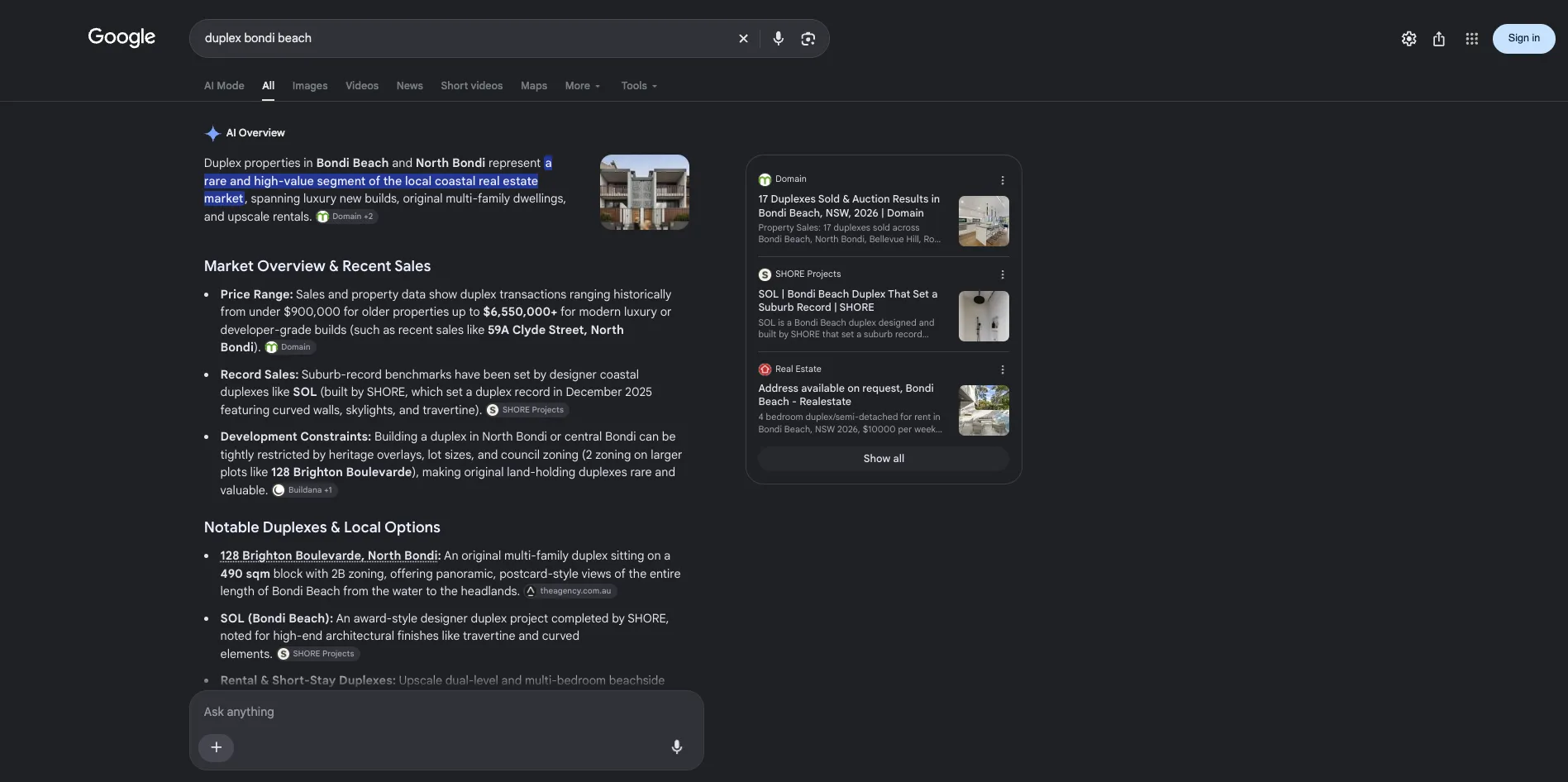
- After Kavera rebuilt SHORE's service and suburb pages, Google's AI Overview for duplex bondi beach named SHORE's SOL duplex and cited its project page.
- The original GEO study tested how content changes improved visibility within generated answers.
What is GEO in marketing? The acronym means generative engine optimisation. Geography, geolocation and location targeting are different uses of the letters. This guide concerns how your business appears when an AI system writes an answer to a customer's question.
For an Australian small business, that raises a practical question: if an answer describes your service, will it name the right business and point to evidence a customer can check? We explain the terms through a real Sydney example from our work with SHORE.
What is GEO trying to improve?
GEO aims to improve a business's presence and the accuracy of its information in generated answers. It focuses on business mentions, descriptions of the work and links to relevant pages.
Those outcomes need different checks. A mention tells you the name appeared. A citation connects the answer to a source. A recommendation presents the business as a possible choice. Enquiry tracking shows how that visibility connects with customer response.
For example, naming a builder's completed project and citing its project page gives the business visibility around that type of work. Reporting the mention and citation separately makes the result clear.
This distinction helps when discussing SEO services for Australian businesses. Ask which customer questions the work addresses and what the report will actually count. The acronym alone does not define the scope.
What does GEO look like for a real Sydney business?
After we rebuilt SHORE's service and suburb pages, Google's AI Overview for "duplex bondi beach" named SHORE's SOL duplex and cited SHORE's project page. Non-brand Google appearances rose from 1,204 to 9,492 (about 7.9x) between the two four-week windows.
Kavera note: We built SHORE's website and run its SEO. Our SEO work began on 21 July 2026. SHORE is our client, so this is an example from our own work.
Before: the captured excerpt discusses the property market
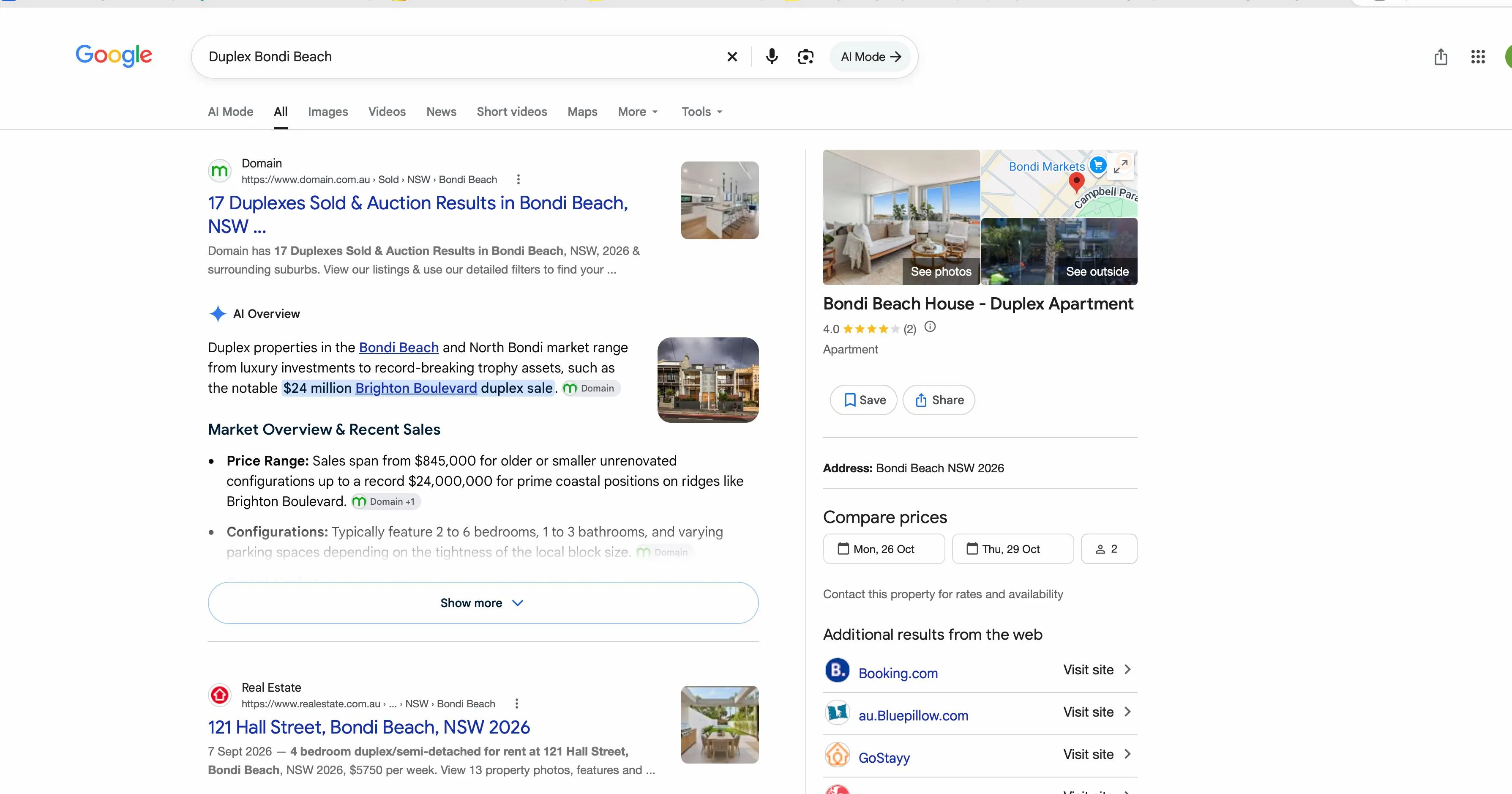
The first screenshot shows an answer about duplex properties and sales with Domain among its visible sources. SHORE is absent from the captured excerpt.
After: SOL appears with SHORE as a source
The second screenshot names SOL in the answer and shows SHORE Projects as a linked source. The source panel also displays SHORE's project page. SHORE appears both in the answer itself and among the sources a reader follows to learn more.
The wider search result gives context
The Google appearance totals cover non-brand searches in Australia across SHORE's website and Maps listing together. The comparison windows are 22 June to 19 July 2026 and 4 September to 1 October 2026.
Source: SHORE progress report, 5 October 2026 and Kavera's SHORE screenshots. Impressions are appearances, not visits. AI answers vary by person, place and time.
Kavera note: Our SHORE work included 17 new service and suburb pages, each with its own projects, local detail and enquiry paths.
See the website in our SHORE website design case study.
The same work changed SHORE's place in ChatGPT. In about two months it went from missing to first for "who is the best custom home builder in the eastern suburbs". See the screenshots in our ChatGPT SEO case study.
SEO vs GEO vs AEO: what is the difference?
SEO covers visibility in search, GEO focuses on generated answers and AEO describes work on direct answers. The terms overlap. Google treats optimisation for its generative search experiences as SEO.3
The comparison below shows the focus of each term and the evidence to include in a search marketing brief.
| Term | Main question for the business | Example of a result | Useful evidence |
|---|---|---|---|
| SEO: search engine optimisation | Can customers find the relevant page through search? | A service page appears for a relevant query | Search impressions, clicks and qualified enquiries |
| GEO: generative engine optimisation | Does an AI answer use and accurately represent our information? | A generated answer names a project and cites its page | The answer, the cited URL and repeated observations |
| AEO: answer engine optimisation | Does our information answer a specific question directly? | A direct-answer format such as a featured snippet | The answer shown and its attributed source |
Some providers use AEO for AI answers generally. Our narrower use here includes direct answers that do not require a newly composed response. Ask the provider to name the platform and result format if the terminology is unclear.
"GEO SEO" usually signals a combined discussion of search and AI visibility. It is more useful to ask whether the work fixes an inaccessible service page, supplies missing project evidence or improves reporting. Each is a concrete task you can review.
How do generative engines choose their sources?
Search-enabled AI systems retrieve information to help compose an answer and may attach source links. Each platform publishes guidance on how it discovers and uses web content.
Google says AI Overviews and AI Mode may issue related searches across subtopics. This is called query fan-out. The sources available for an answer can therefore extend beyond the results for the exact words you typed.2
Our worked illustration below shows how the buyer prompt "who builds duplexes in Bondi?" could fan out into related questions. It illustrates Google's documented query fan-out concept; these are hypothetical sub-questions, not a capture of Google's actual searches.2
| Possible sub-question | Page type that could answer it |
|---|---|
| Which builders offer duplex construction? | Duplex service page explaining the work offered |
| Which of those builders work in Bondi? | Service-area page with genuine local coverage |
| What duplexes have they completed nearby? | Project page with the location, photos and builder's role |
| Do they handle design as well as construction? | Design and build process page explaining responsibilities |
OpenAI says ChatGPT can rewrite a question into targeted searches and use location or relevant conversation context. Its guidance recommends opening cited sources to check that they support the answer.6
Google, ChatGPT and Perplexity have different access controls
Google's AI search sources need search eligibility and applicable participation settings; ChatGPT and Perplexity have their own search-access controls.2478 Search discovery and permission to use content for model training are separate decisions. Our AI SEO crawler settings guide explains which controls to review.
Being named and being cited are separate checks
When an answer names your business and links to a directory, it combines a business mention with a third-party citation. A link to your own project page is a direct citation to your website. Record both the name shown and the page receiving the link.
For reporting, keep the exact answer and the destination of each relevant link. Check the name, location and described service together to identify the right business.
Where did the term GEO come from?
The research paper "GEO: Generative Engine Optimization" by Pranjal Aggarwal and colleagues introduced a framework for improving visibility in generative-engine responses. Its first arXiv submission was in November 2023 and it was accepted to KDD 2024.1
The authors tested content changes such as adding citations, quotations and statistics. They reported visibility improvements of up to 40% in their evaluation, with results varying by domain. Their measures concerned representation within generated answers.1
The research gives business owners a useful question to ask about a GEO report: which content changes were tested and how was answer visibility measured?
What changes for an Australian small business?
GEO adds another place to check how potential customers encounter your business. It makes the accuracy of the answer worth reviewing alongside whether your website appears in search.
Consider a customer trying to establish whether you handle a particular job in their suburb. A useful answer needs the correct service area and a relevant example. A mention attached to the wrong location or an unavailable service creates a poor starting point for an enquiry.
Make the facts behind those decisions clear: the service offered, where it is available and what your completed work demonstrates. Australian context comes from the real business and its local experience.
The SHORE example connects a named duplex project with Bondi Beach and the business that built it. That gives a prospective customer a specific piece of work to explore.
For the practical workflow, see our guide to AI SEO and getting your business recommended in AI search. That guide covers implementation; this page explains what the terms and results mean.
Does GEO require special files, schema or AI-written content?
Google says it does not use llms.txt for Search and requires no special schema for its generative features. Its guidance also rejects the idea that content must be broken into tiny sections or rewritten in a special style for AI.3
Clear headings and concise answers help readers find what they need. Use them to organise the page around the customer's questions.
Structured data describes a page's content in a machine-readable form. Keep it consistent with the visible text, including the author, business details and information on the page.2 FAQs can still answer customer questions even though Google stopped showing FAQ rich results in Search from 7 May 2026.9
Using AI to help write a page is a production choice. GEO describes the visibility being pursued. A draft still needs someone who understands the business to check its claims, sources and scope before it goes live.
How should you judge a GEO result?
Judge GEO through visibility, accuracy and business response. A mention, citation, recommendation and enquiry are different results: being named or linked does not establish that a customer chose or contacted the business.
Google's Generative AI performance report shows impressions from AI Overviews and AI Mode, with dimensions such as page, country and device. It becomes available when a site receives enough impressions in these features.5
Our AI SEO measurement method explains how to compare repeated answers, track referral visits and assess qualified enquiries separately.
When comparing SEO services for Australian businesses, ask for this level of specificity in the scope and reporting: which customer questions, which pages and which observable outcomes. A proposal should make the work understandable before asking you to value the acronym.
Common questions
What is GEO SEO?
GEO SEO is a phrase used for SEO work that also considers how a business appears in generated answers. For a small business, the useful distinction is what gets measured: search visibility, correct mentions, linked citations and enquiries. Ask for the actual work and reporting behind the label before treating it as a separate service.
Does GEO replace SEO?
GEO does not replace SEO. Google describes optimisation for its generative search features as part of SEO because those features depend on its search systems. A useful page still needs to be discoverable and suitable for the customer. GEO adds questions about how AI answers represent the business and whether they cite an appropriate source.
What's the difference between GEO and AEO?
GEO means generative engine optimisation and focuses on answers composed by AI systems. AEO means answer engine optimisation and also covers direct answers such as featured snippets. The terms overlap in agency services. Ask which platforms and answer formats the work targets so you understand how each part contributes to your search marketing program.
How long does GEO take to show results?
The timing of GEO results depends on the platform, the website's starting point and the work being done. Agree review dates at the start of the program. Compare the same customer questions and pages at each review, then assess changes in source citations, the accuracy of business descriptions and enquiries.
What are the KPIs for GEO?
Useful GEO measures include how often a business is cited in a defined answer sample, whether its description is accurate and whether visitors become qualified enquiries. Google also provides a Generative AI performance report for Search impressions. Record the platform, period and sample size with each measure to make progress easy to compare.
Is GEO only relevant for big brands?
GEO is relevant to small businesses whose expertise or services answer the questions customers ask AI tools. SHORE's Sydney duplex example shows a local business appearing in a generated answer with a link to its project page. Clear service information and specific examples of completed work give customers useful material to assess.
Sources
- GEO: Generative Engine OptimizationAggarwal et al., arXiv; accepted to KDD 2024. Accessed .
- AI features and your websiteGoogle Search Central. Accessed .
- Optimizing your website for generative AI features on Google SearchGoogle Search Central. Accessed .
- Search generative AI controlGoogle Search Console Help. Accessed .
- Generative AI performance report (Search)Google Search Console Help. Accessed .
- Searching the web with ChatGPTOpenAI. Accessed .
- Overview of OpenAI CrawlersOpenAI. Accessed .
- Perplexity CrawlersPerplexity. Accessed .
- Latest documentation updates: FAQ rich result removalGoogle Search Central. Accessed .
Let’s talk.
Tell us what your business needs and we will point you to the right option.
SEO services for Australian businesses