
AI search
Which tradies does ChatGPT recommend? A Sydney trades index
The quick answer
When we asked ChatGPT which tradies a Sydney homeowner should hire, it named 122 different businesses across 50 answers. Of the 47 questions all four AI tools answered in full, only 6 had a business that every tool named. These are names we saw, not recommendations from us. The question and the tool you use both change the result.
On this page
Key takeaways
- We wrote 50 questions across 10 trades before we collected any answers.
- We planned 200 checks (50 questions in four AI tools) and got 197 full answers.
- An AI tool naming a business and linking to its website are two different things.
- Our download files keep failed checks separate from answers that named no tradie.
We asked four AI tools who a Sydney homeowner should hire and wrote down every business they named. The tools often named different businesses for the same question, so being named by one of them doesn’t mean you’re named by all of them. Below is what we found and five checks you can run on your own business.
We collected the answers on 16 and 17 October 2026 and call the result our Sydney trades AI search index. It shows what appeared in the answers we saved and doesn’t judge the quality of any business on it.
What happens when a homeowner asks AI for a tradie?
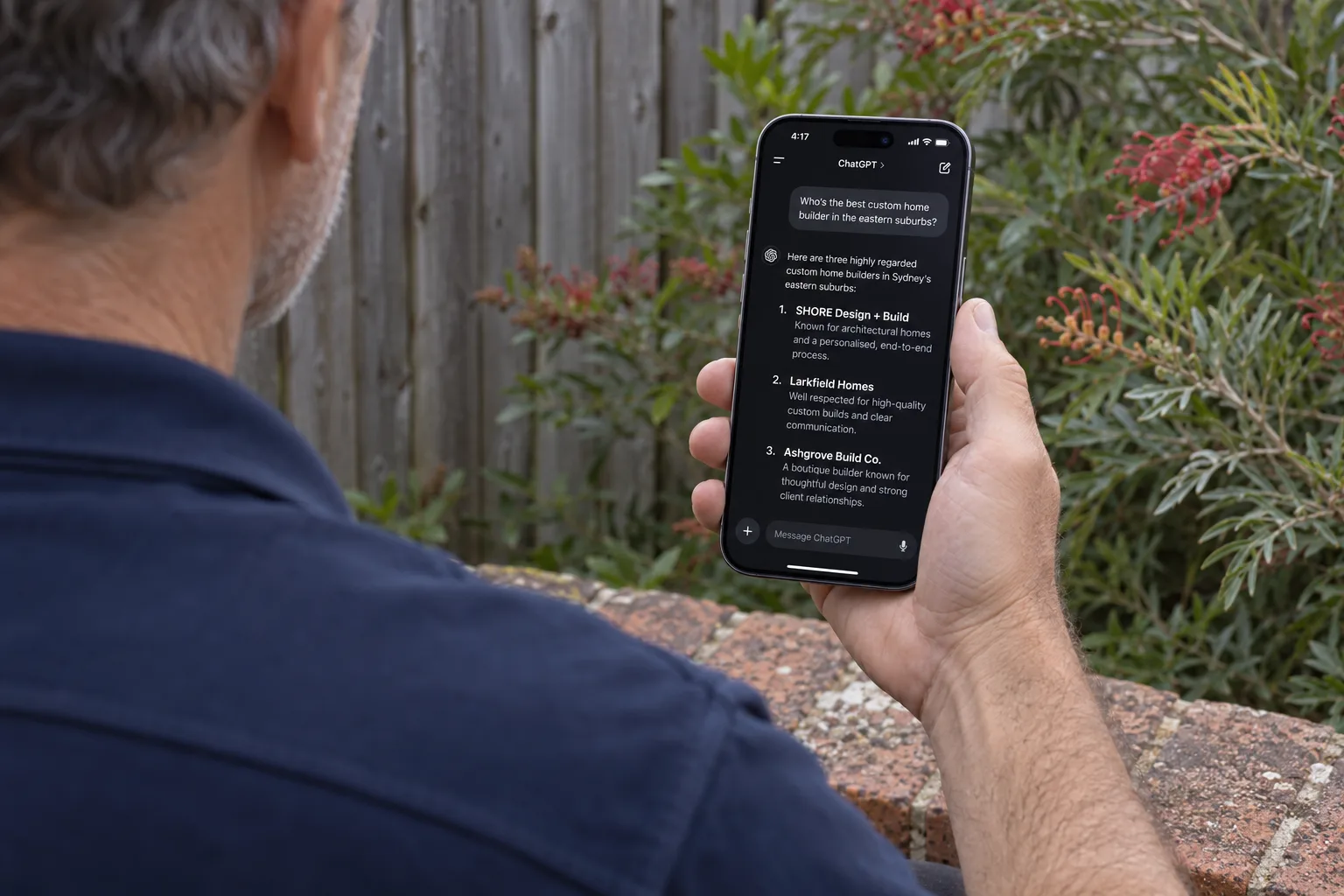
Here’s an example. A homeowner in Parramatta has a leaking tap. They don’t open Google and scroll through ten links. They type “Who’s a good plumber near Parramatta?” into ChatGPT and get back a short list of business names, some with a link beside them. The homeowner rings the first one that looks right.
Now picture two plumbers a few streets apart who are both good at their job. One is named in the answer with a link to its website and the other isn’t mentioned at all. That second plumber never finds out about the call they missed.
That’s what we wanted to measure. We wanted to see who gets named and who gets a link, while also checking whether the different AI tools agree with each other.
So we made a record any trade business owner could check for themselves, with the actual question, the names the tool returned and the links shown beside them. We checked four tools:
- ChatGPT, the AI chat assistant from OpenAI.
- Google AI Mode, Google’s chat-style AI search.
- Google AI Overviews, the AI summary that sometimes shows at the top of Google results.
- Perplexity, an AI search tool.
What did we find?
- ChatGPT named 122 different businesses across 50 answers. In each tool, the most-named business showed up in only 3 or 4 answers.
- The tools didn’t agree much. All four tools gave a full answer to 47 questions. Only 6 of those had a business that every tool named.
- A name and a link are different things. A tool can name your business and link to a directory, a review site or a government page instead.
- ChatGPT linked to a government page in 34 of its 50 answers.
What should you do about it?
These five checks come from what we saw in the answers. We haven’t tested whether any of them changes who gets named.
- Pick the work you want more enquiries for. Write a few questions that name the job and the area you actually serve. Ask each AI tool and save every answer.
- Look at what sits beside each business that gets named. If the link goes to a service page, read how that page describes the job and the area. If it goes to a directory or review page, check that your own profile there is accurate.
- Notice when the AI asks for more detail. If it asks about your suburb or the exact job, your service page should answer that question clearly.
- Make your own pages useful to a homeowner comparing options. Explain the jobs you take on, where you travel and how a customer can ask for a quote. Use real project details and publish only what you can stand behind. Our Local SEO service covers the local search work around those pages and profiles.
- If the answers keep leaving you out, bring them to us. Take your saved questions and answers to our AI SEO agency. We can go through the gaps with you and pick which work comes first.
Which tradies does ChatGPT recommend?
ChatGPT named 122 different businesses across its 50 full answers. A full answer is one the tool finished, which the data files call a completed answer. We counted a business when the answer named it as a tradie you could hire for the job, with the exact counting rules in the fine print below.
If you want to go through the questions that matter to your trade, talk with our AI SEO agency and start with the saved answer that prompted your question.
This table shows the business each tool named most often. The number is how many answers named that business, with each business counted once per answer, so it’s a count and not a score for the business. No business was named in more than 4 answers in any one tool, with ties shown together.
Scroll across to read every column
| Tool | Most-named business | Answers naming it / full answers |
|---|---|---|
| ChatGPT | Ready Set Plumb | 3/50 |
| ChatGPT | Secure.Lock Locksmiths | 3/50 |
| Google AI Mode | AKD Painting | 4/49 |
| Google AI Overviews | Sydney Wide Roofing Co | 4/48 |
| Perplexity | Brushworks | 4/50 |
The full business appearances file lists the question, the trade and the order each name first appeared in, for every name we saw. Read the saved answer data before you judge any single appearance.
Do the AI tools name the same tradies?
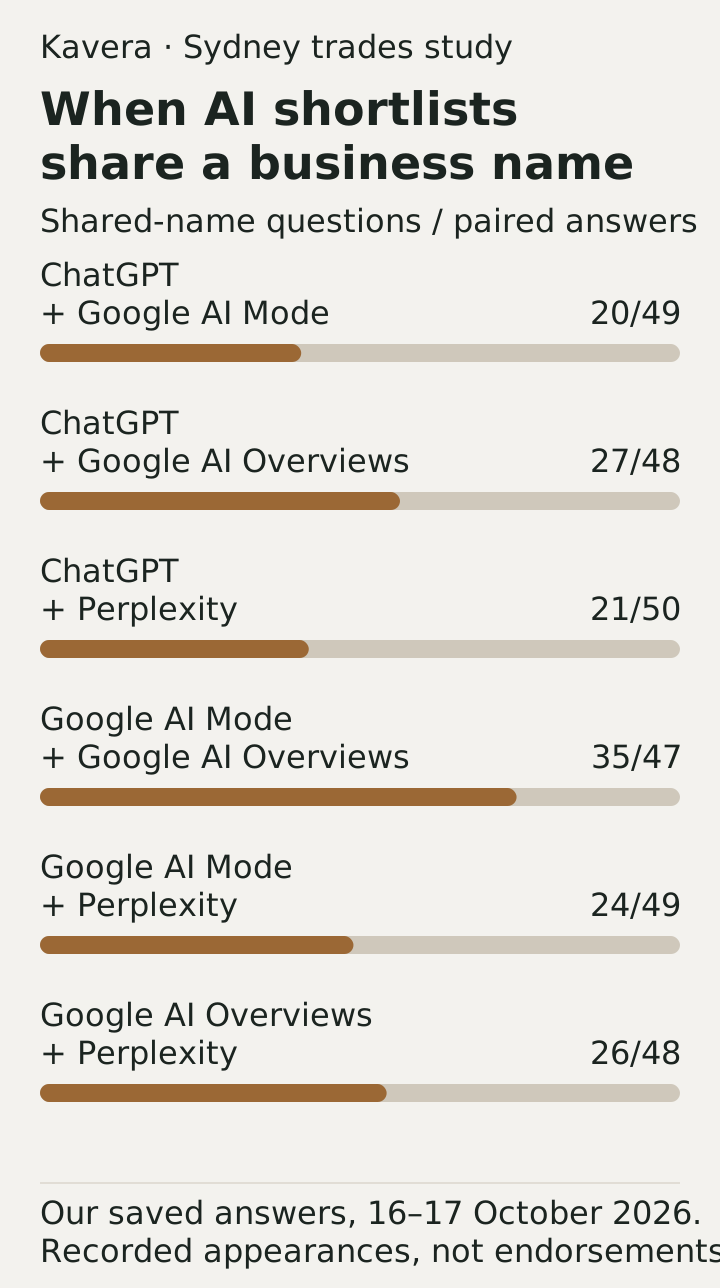
Not often. All four tools gave a full answer to 47 of our questions and only 6 of those had a business that every tool named.
Here is how each pair of tools compared. We only compared a pair on questions that both tools answered in full, so the table shows how many of those questions had at least one business named by both.
Scroll across to read every column
| Pair of tools | Questions where both named the same business / questions both answered |
|---|---|
| ChatGPT + Google AI Mode | 20/49 |
| ChatGPT + Google AI Overviews | 27/48 |
| ChatGPT + Perplexity | 21/50 |
| Google AI Mode + Google AI Overviews | 35/47 |
| Google AI Mode + Perplexity | 24/49 |
| Google AI Overviews + Perplexity | 26/48 |
Even the two Google tools shared a business name on only 35 of 47 questions, while ChatGPT and Google AI Mode were furthest apart at 20 of 49.
We can’t tell you why a business was named, because we didn’t change any websites, review profiles or location settings to test it. An AI tool can also give a different answer the next time you ask.
Which websites did the AI link to?
A tool can name your business and link to somewhere else, so we tracked the name and the link separately. A link might go to a directory, a review site or a community discussion, while a tool’s source panel can also list pages that the visible answer doesn’t link to directly.
This table shows how many full answers had at least one link of each type.
Scroll across to read every column
| Type of link | ChatGPT: answers / full answers | Google AI Mode: answers / full answers | Google AI Overviews: answers / full answers | Perplexity: answers / full answers |
|---|---|---|---|---|
| directory | 8/50 | 2/49 | 6/48 | 14/50 |
| review platform | 4/50 | 1/49 | 0/48 | 0/50 |
| community forum | 0/50 | 4/49 | 1/48 | 0/50 |
| Google business or map record | 0/50 | 2/49 | 0/48 | 0/50 |
| editorial list or guide | 0/50 | 0/49 | 1/48 | 4/50 |
| government | 34/50 | 8/49 | 4/48 | 1/50 |
| other or business website | 50/50 | 36/49 | 47/48 | 49/50 |
An answer can link to several types at once, so don’t add the columns up into a percentage. We counted Google’s expanded source cards but counted Google business and map records separately from business websites.
Two things stand out. ChatGPT linked a government page in 34 of 50 answers, while Perplexity did so in 1 of 50. Perplexity linked a directory in 14 of 50 answers, while ChatGPT did so in 8 of 50.
We also checked whether the answer linked to the named business’s own website. For ChatGPT, we could match the business’s own website in 140 of 144 name appearances, while the other tools were lower:
- Google AI Mode: 77 of 253.
- Google AI Overviews: 101 of 214.
- Perplexity: 182 of 240.
The chart below shows the same four numbers as bars. The longer the bar, the more often we could match the business’s own website.
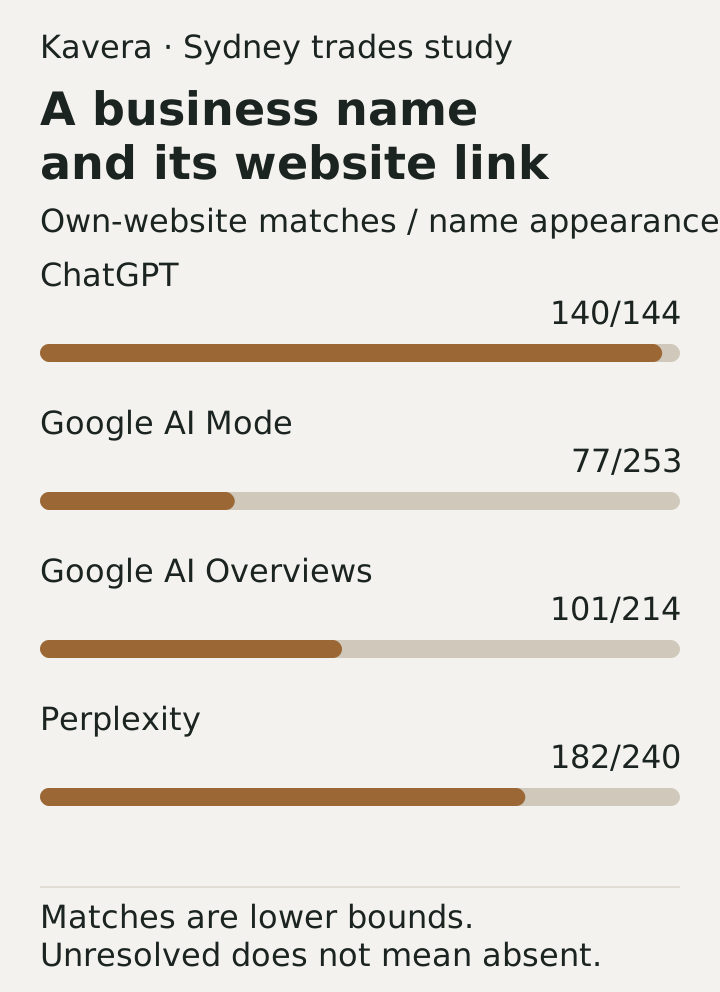
Most of the gap is links we couldn’t trace to a business, so these figures are minimums. The matching rules and the full table are in the fine print. The citation review shows the evidence for each match.
This table shows which websites were linked most often. Each number is how many full answers linked to that website.
Scroll across to read every column
| Website | ChatGPT: answers / full answers | Google AI Mode: answers / full answers | Google AI Overviews: answers / full answers | Perplexity: answers / full answers |
|---|---|---|---|---|
| service.nsw.gov.au | 21/50 | 3/49 | 1/48 | 0/50 |
| hipages.com.au | 6/50 | 1/49 | 5/48 | 12/50 |
| nsw.gov.au | 12/50 | 1/49 | 1/48 | 1/50 |
| brushworks.com.au | 1/50 | 3/49 | 2/48 | 3/50 |
| sydneywideroofingco.com.au | 1/50 | 2/49 | 4/48 | 2/50 |
| airtasker.com | 0/50 | 2/49 | 6/48 | 1/50 |
| thequoteyard.com.au | 0/50 | 2/49 | 3/48 | 4/50 |
| readysetplumb.com.au | 3/50 | 2/49 | 1/48 | 1/50 |
These are links we saw and not a list of websites we tell every tradie to join. We haven’t tested whether getting a listing on any of them would change an answer. OpenAI says the Sources view in ChatGPT can show the sources it cited as well as other relevant links,1 which is why we kept the two kinds of link apart.
Which trades did we check?
We asked about 10 trades with 5 questions each: plumber, electrician, builder, roofer, painter, landscaper, air conditioning, pest control, locksmith and carpenter. Some questions asked broadly for a recommendation and others asked about a specific household job, because finding someone to replace a porch light is a different request from finding someone to upgrade a switchboard.
Each cell below shows how many business names appeared and then how many answers there were, so 15 / 5 in the ChatGPT plumber cell means 15 names across 5 answers.
Scroll across to read every column
| Trade | ChatGPT: name appearances / answers | Google AI Mode: name appearances / answers | Google AI Overviews: name appearances / answers | Perplexity: name appearances / answers |
|---|---|---|---|---|
| Plumber | 15 / 5 | 25 / 5 | 16 / 4 | 22 / 5 |
| Electrician | 10 / 5 | 21 / 4 | 26 / 5 | 20 / 5 |
| Builder | 15 / 5 | 28 / 5 | 25 / 5 | 25 / 5 |
| Roofer | 15 / 5 | 26 / 5 | 24 / 5 | 23 / 5 |
| Painter | 15 / 5 | 29 / 5 | 22 / 5 | 24 / 5 |
| Landscaper | 18 / 5 | 28 / 5 | 21 / 5 | 26 / 5 |
| Air conditioning | 15 / 5 | 26 / 5 | 21 / 5 | 33 / 5 |
| Pest control | 13 / 5 | 25 / 5 | 22 / 5 | 23 / 5 |
| Locksmith | 13 / 5 | 25 / 5 | 17 / 4 | 18 / 5 |
| Carpenter | 15 / 5 | 20 / 5 | 20 / 5 | 26 / 5 |
These numbers show how much our questions covered. They don’t tell you how many businesses each trade has in Sydney or how often homeowners search for them.
What if an AI answer names no tradie?
Almost every check gave us a usable answer. We planned 200 checks and 197 ended in a full answer, because one Google AI Mode check failed to record and Google showed no AI Overview for 2 questions.
A different case is a full answer that names no tradie at all. That happened 3 times in 50 answers for Perplexity and never in the other three tools. The table keeps both cases visible.
Scroll across to read every column
| Tool | Full answers | Blocked | Failed | No Overview | Named no business / full answers |
|---|---|---|---|---|---|
| ChatGPT | 50 | 0 | 0 | 0 | 0/50 |
| Google AI Mode | 49 | 0 | 1 | 0 | 0/49 |
| Google AI Overviews | 48 | 0 | 0 | 2 | 0/48 |
| Perplexity | 50 | 0 | 0 | 0 | 3/50 |
“Blocked” means the tool put up a barrier such as a login request or a usage limit, “Failed” means our recording went wrong and “No Overview” means Google’s results page showed no AI Overview. None of these counts as a business missing from an answer.
One answer was a clear mix-up. Perplexity read our Canterbury lock-change question as Canterbury in England, because that question didn’t say Sydney, so an empty list there doesn’t mean Sydney locksmiths were missing from a correctly located answer. Some other answers also used overseas sources for places with matching names.
How we ran the study
We wrote 50 questions and locked them before we collected any answers. None of them names a business. We based them on household jobs and recommendation requests from 27 public Reddit and Whirlpool discussions, written in our own words rather than copied from search logs. The question set and source register keeps the wording, trade, region and source for every question.3
We asked each tool each question once, using ChatGPT, Google AI Mode, Google AI Overviews and Perplexity. Every question started a fresh conversation or search without follow-up questions or regenerated answers. We never put a business name into a question. The saved records show any check that was blocked before we could ask.
We used our existing signed-in Chrome account. Google showed our location as Inner West Council, Sydney NSW, from our IP address, while ChatGPT and Perplexity showed no location label in the answer. We didn’t change any location permissions or look at account memories. ChatGPT showed Pro and Perplexity used its existing Search mode, so someone else’s run may not match ours exactly.
For every answer, we saved the full visible text, the capture time, the business names in order and the visible source links. We waited for the answer to finish before counting it. Where a group of citations showed its destinations, we recorded them. Where it didn’t, those links stay unresolved, because we had nothing to record.
The data bundle holds the records and the recompute script, so you can repeat our arithmetic from the download. If you repeat the browser run, you may get different answers. The public download leaves out account identifiers and private conversation links but keeps the visible answer text and source URLs.
The fine print
How we counted
- What counts as a business name. A name counted when the answer presented it as a trade service provider. We left out adverts, product manufacturers, utilities and businesses that only appeared as source labels.
- How names were matched. We kept each name as the tool wrote it. To compare tools, we ignored punctuation and capital letters and dropped the legal suffix “Pty Ltd”. Other spelling differences stay separate even when they may be the same operator. So our shared-name counts can understate how many businesses were shared.
- What the pair table compares. Each pair count only includes questions that both tools answered in full. “Shared a name” means both answers contained the same business name after the matching above. An answer that named no tradie stays in the count. A blocked check or a missing AI Overview doesn’t.
- The trade table. The counts show the coverage of our question set. They don’t measure how many Sydney businesses exist in each trade or how often homeowners search for them. Several questions came from the same public discussion, so the questions are related. They aren’t independent observations of homeowners.
- The link tables. Each cell counts full answers with at least one captured source link of that type. Perplexity’s research-only source-panel links are in the download but not in these tables.
- Name appearances. A business counts once per answer. An appearance can include a warning or a note that a provider may not suit the job. So these counts aren’t endorsement totals.
Matching names to websites
We counted an own-website match only when the answer presented a visible destination as belonging to the named business. The table shows the name and the website appearing in the same answer. It doesn’t show which sentence a grouped citation supports and it doesn’t check who legally owns the domain. A directory match also needs a visible destination that the saved evidence ties to the named business. Both counts are minimums. Categories can overlap. A case we couldn’t resolve isn’t evidence that a website was absent.
Scroll across to read every column
| Tool | Own website / name appearances | Directory / name appearances | Own website unresolved / name appearances |
|---|---|---|---|
| ChatGPT | 140/144 | 10/144 | 2/144 |
| Google AI Mode | 77/253 | 8/253 | 170/253 |
| Google AI Overviews | 101/214 | 8/214 | 113/214 |
| Perplexity | 182/240 | 17/240 | 53/240 |
What the numbers can’t tell you
Our second study asks 50 questions about salons and beauty services. Read the Sydney beauty AI search index for its separate question set, results and limits.
This is a convenience sample of questions across Sydney trades. It isn’t a survey of homeowners, a count of every local business or a league table of workmanship. We didn’t check the prices, reviews, licence claims or availability the tools stated, so check any contractor yourself before you hire by using the official licence lookup from Service NSW.2
We didn’t reset our account between questions. A fresh conversation cuts direct carry-over from earlier messages but doesn’t prove that account memory or personalisation had no effect. The collection also ran across two days, so a tool may have changed during the run. A missing name only means we didn’t see it in the answers we captured.
Using the data
Researchers and journalists can download the question set, answer records, business appearances and calculation script from this page. When you cite a result, give the collection date, the tool and the number of answers it came from. Keep the question wording with any single example.
Read the answers
See what each AI tool said for all 50 questions, one page per trade. Each answer shows the businesses it named in order and the links it showed.
Raw data for researchers (JSON)
- Question set
- Saved answers
- Citation review
- Calculated results
- Business appearances in the original CSV format
- Calculation script
- Data bundle with every raw file above
Want help checking your own business?
Bring a question your customers ask and the answer you saw. We can use that real example to talk through your next SEO step.
Search appearances are not guaranteed.
Good questions
Common questions Clear answers
Why does my suburb matter?
Sometimes the AI tools asked for a suburb after their first answer. That matters because a question about Sydney and a question about one suburb are different jobs. When you check over time, keep your location wording the same. Our results cover the questions we saved. They don’t cover every suburb a business serves.
Why describe the exact job?
Asking for a plumber and asking someone to fix a cistern inside a wall are different requests. Our saved answers include follow-up questions about the work needed. For your own check, use the jobs you want enquiries for. Save the first answer before you add details so you can compare cleanly.
What should I ask a tradie?
An AI shortlist is only a place to start. Ask whether the business does your exact job. Ask what it needs to give you a quote and what charges apply before work begins. Our study records names and links. It doesn’t check workmanship, availability, reviews or the price you would pay.
How do I check a licence?
Use the Service NSW licence checker. Don’t treat an AI mention as proof. You can search by licensee name, licence number or business number. Match the result to the contractor you are thinking of hiring. We didn’t check the current licence status of any business in this study.
Sources
- Searching the web with ChatGPTOpenAI. Accessed .
- Check a builder or tradesperson licenceService NSW. Accessed .
- Finding a trustworthy plumber - do you trust Google reviews?Reddit r/sydney. Accessed .