

AI search
Australian AI search usage and statistics for 2026
The quick answer
In a YouGov survey from April to May 2026, 35% of Australian adults who search online at least weekly said they used an AI assistant to find information in the past 30 days. Roy Morgan found 45% of Australians aged 14 and over used ChatGPT in an average four weeks. These count different things, so don’t add them.
On this page
Key takeaways
- 35% of Australian adults who search online at least weekly used an AI assistant to find information in the past 30 days (YouGov, April to May 2026).
- 45% of Australians aged 14 and over used ChatGPT in an average four weeks, an estimated 10.5 million people (Roy Morgan, January to March 2026).
- 4% of Australian online searchers said they usually start finding a local place with AI (YouGov, April to May 2026).
- 39% trusted information from AI assistants, against 63% for search engines, in the same YouGov survey.
- 12% of Australian employing businesses in the Australian Bureau of Statistics survey used AI in the 2024-25 financial year.
Australian AI search statistics for 2026 show that AI is now common but isn’t where most local searches start. More than half of Australians aged 14 and over used an AI tool in an average four weeks of early 2026.1 Among adults who search online at least once a week, 35% said they used an AI assistant to find information in the past 30 days.2 But 4% said they usually start looking for a local place with AI.2
Here’s an example. A homeowner in Penrith wakes up to a dead hot water system. One neighbour types “plumber near me” into Google while another asks ChatGPT who to call. The numbers on this page show how many Australians use AI tools, how they use them to find information and how far they trust what the tools say. We found no national figure for how many people ask ChatGPT who to call for a job like this one, so the second neighbour is an illustration and not a measured habit.
This page collects the main figures we could find from original surveys and official releases and explains each one in plain words. Every number shows who was asked and when. Journalists and researchers can follow each figure to its source. The fine print holds the definitions. Last updated 21 October 2026, with sources checked on 20 and 21 October 2026.
Australian AI search statistics at a glance
These five figures are the safest to quote. They don’t all describe the same group of people, so each one says who was asked and we don’t add them together.
- 35% of Australian adults who search online at least weekly said they used an AI assistant (a chat tool such as ChatGPT) to find information in the past 30 days.2 YouGov asked them between 21 April and 29 May 2026.2
- 45% of Australians aged 14 and over used ChatGPT in an average four weeks of January to March 2026, an estimated 10.5 million people.1 That counts any use of the tool, such as writing an email.1
- 4% of Australian online searchers said they usually start finding a local place with AI.2 This is the same YouGov survey as the first figure.2
- 39% of those online searchers trusted information from AI assistants somewhat or a lot, compared with 63% for search engines.2
- 12% of Australian employing businesses in the Australian Bureau of Statistics (ABS) survey used AI in the 2024-25 financial year.9 The ABS only counts businesses with staff and only asks whether they used AI at all.9
These studies don’t show AI replacing Google. YouGov’s report says most people who use AI also use other sources, as the next sections show.2 If you run a local business, the section for a tradie turns these figures into steps. Our AI SEO agency can help you work through them.
How many Australians use ChatGPT, Gemini and Copilot?
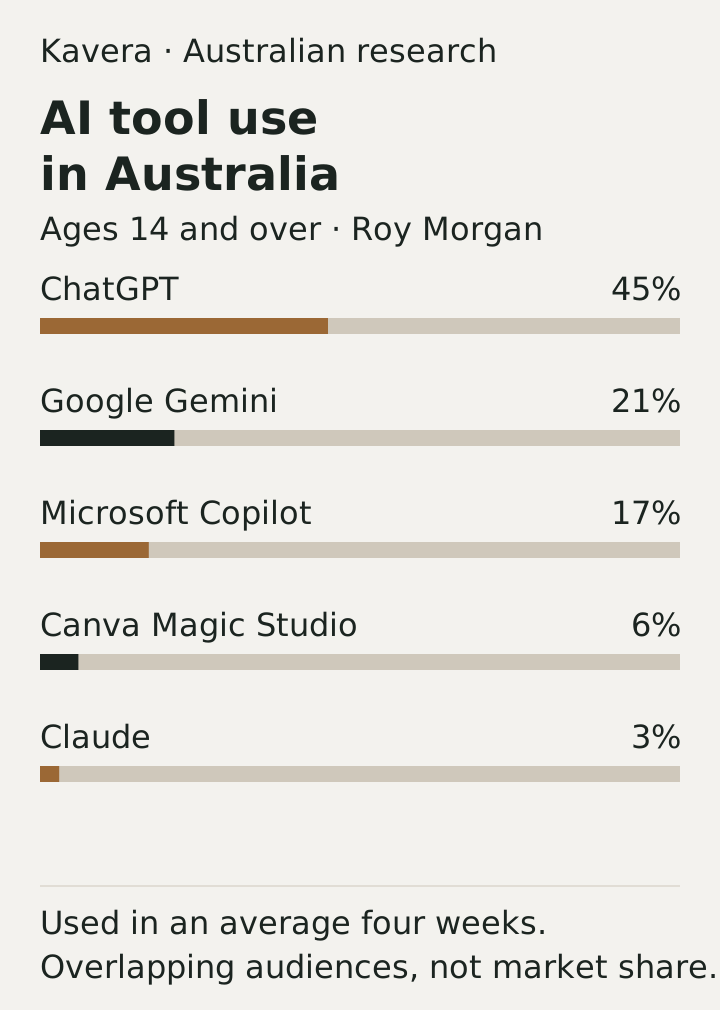
About 45% of Australians aged 14 and over used ChatGPT in an average four weeks of January to March 2026, which Roy Morgan estimates at 10.5 million people.1 It was the most used of the tools Roy Morgan reported.1 Roy Morgan surveyed 14,646 Australians aged 14 and over.1
Scroll across to read every column
| AI tool | Share of Australians aged 14 and over | Estimated people |
|---|---|---|
| Any AI tool | 58% | 13.6 million |
| ChatGPT | 45% | 10.5 million |
| Google Gemini | 21% | 5 million |
| Microsoft Copilot | 17% | 4 million |
| Canva Magic Studio | 6% | 1.4 million |
| Claude | 3% | 777,000 |
These numbers count people who used a tool for anything, such as writing an email or making a picture.1 They don’t count searches.1 People use more than one tool, so the rows overlap and shouldn’t be added up.
Gemini here means people who actively used Gemini itself.1 It leaves out the AI summaries Google shows inside its normal search results.1 We didn’t find a trustworthy Australian user count for those summaries, for Google’s chat-style AI Mode or for Perplexity, so we haven’t quoted one.
How do Australians use AI to find information?
YouGov’s report says most people who use AI for answers use it as part of a wider search.2 It asked 1,002 Australian adults between 21 April and 29 May 2026.2 More than 950 of them were online searchers, which YouGov defines as adults who look for information online at least once a week.2 Of those, 35% said they had used an AI assistant or chatbot to look for information in the past 30 days.2 Search engines were still the most used source.2
YouGov also names anyone who starts at least some new questions with an AI assistant as an AI searcher.2 That includes people who do it less than once a week.2 They made up 72% of the Australians surveyed, which was more than 700 people.2 Among them, 43% use AI alongside other sources and 16% call it their starting point.2 Every number in this table is out of that group.2
Scroll across to read every column
| What YouGov asked | Answer | Share | Report page |
|---|---|---|---|
| What role does an AI assistant play when you look for information? | AI is my starting point | 16% | 18 |
| I use AI alongside other sources | 43% | 18 | |
| What happens most often after an AI answer? | I click through to the links AI gives | 31% | 19 |
| I stop searching | 15% | 19 | |
| What do you use an AI assistant for? (more than one answer allowed) | Answering a question directly | 50% | 17 |
| Comparing options | 35% | 17 | |
| Planning or getting recommendations | 29% | 17 |
These are answers people gave about what they do, so no tool counted their clicks.2 The rest of the people in each question chose other answers.
Which age groups use AI the most?
AI tool use was highest among Australians aged 25 to 34 at 74% and lowest among those aged 65 and over at 31%.1 This is the same Roy Morgan survey and the same four-week measure for every row.1
Scroll across to read every column
| Age group | Used an AI tool in an average four weeks |
|---|---|
| 14 to 17 | 66% |
| 18 to 24 | 68% |
| 25 to 34 | 74% |
| 35 to 49 | 72% |
| 50 to 64 | 50% |
| 65 and over | 31% |
AI tool use by age, January to March 2026
Share who used an AI tool in an average four weeks
Roy Morgan · January to March 2026
Self-reported tool use, not searches.
YouGov asked a narrower question: how many new questions people start with an AI assistant to find information.2 Daily use was far more common among younger adults.2
Scroll across to read every column
| Generation | Start at least one new AI question a day |
|---|---|
| Gen Z (born 1997 or later) | 59% |
| Millennials (born 1981 to 1996) | 48% |
| Gen X (born 1965 to 1980) | 25% |
| Baby Boomers and older (born before 1964) | 14% |
| All online searchers | 36% |
Daily AI questions by generation, April to May 2026
Share who start at least one new AI question a day
YouGov · 21 April to 29 May 2026
Online searchers only. All online searchers: 36%.
The two tables answer different questions, so read them one at a time. Roy Morgan counts anyone who used a tool in four weeks.1 YouGov counts how often people start a new question each day.2
Place is harder to pin down. In auDA’s 2025 survey, 59% of adults in the five major capital cities said they used AI for at least one purpose on its list, against 56% of all adults.4 That is a small gap. The five cities are Sydney, Melbourne, Brisbane, Adelaide and Perth.4 Of the 2,000 adults surveyed, 1,305 lived there.4 The survey ran in February and March 2025, so it is older than most of the other figures.4 We found no published figure for people outside those five cities and we haven’t worked one out, because the published results are rounded and weighted.
A separate eSafety survey asked 1,950 children aged 10 to 17 between 2 February and 4 March 2026.12 Of them, 78% had used an AI assistant.12 That is a different age range and a different question, so we don’t compare it with the tables above.
Do Australians trust AI answers?
Fewer Australian online searchers trust AI assistants than trust search engines.2 In the YouGov survey, 39% of online searchers trusted information from AI assistants somewhat or a lot, against 63% for search engines.2 Both numbers come from the same question and the same people.2
Trust in two sources of information, April to May 2026
Trust somewhat or a lot
YouGov · 21 April to 29 May 2026
Self-reported trust, not accuracy.
Trust is a feeling and isn’t a test of accuracy. Other surveys ask about trust in different ways, so their numbers don’t line up with YouGov’s.
Scroll across to read every column
| Survey | What people were asked | Result | When |
|---|---|---|---|
| Ipsos for Google5 | How much they trust AI to provide accurate information (answers of a fair amount or a great deal) | 54% (42% plus 12%, with rounding)6 | 22 September to 10 October 2025 |
| University of Melbourne and KPMG11 | Whether they are willing to trust AI | 36% | November 2024 to mid-January 2025 |
We can’t draw a trend from these rows because they ask about different things at different times. Ipsos ran its survey for Google.5
Are Australians using AI to find local businesses?
Not as a first step for most people. In the YouGov survey, 4% of online searchers said they usually start finding a local place with AI.2 The report shows search engines as the most common starting point for most tasks it tested, with maps apps the runner-up for finding a local place.2
That question let each person pick one usual starting point.2 It doesn’t count people who ask AI later in their search. A local place also covers more than hiring a tradie. We found no national figure for how many Australians use AI to hire a tradie or book a local service.
We tested what AI tools say when someone asks for a tradie and published the answers in our Sydney trades AI search study. ChatGPT named 122 different businesses across 50 full answers. Four tools gave a full answer to 47 of our questions. Only 6 of those had a business that every tool named. We planned 200 checks and got 197 full answers. This is a sample of what the tools said to our questions on 16 and 17 October 2026. It doesn’t measure what Australians do.
How do Australian businesses use AI?
The Australian Bureau of Statistics found that 12% of Australian employing businesses used AI in the 2024-25 financial year.9 Other surveys give much higher numbers.73 They ask different businesses different questions, so the figures aren’t like for like.
The ABS only counts businesses that have staff.9 If you’re a sole trader with no employees, this figure doesn’t include you.9 It also leaves out some industries and records only whether a business used AI at all.9 The table shows selected industries from its results, so it isn’t a full ranking.9
Scroll across to read every column
| Industry | Businesses that used AI in 2024-25 |
|---|---|
| Information, media and telecommunications | 38% |
| Professional, scientific and technical services | 24% |
| Retail | 9% |
| Construction | 6% |
| Accommodation and food services | 5% |
AI use in selected industries, 2024-25
Share of employing businesses that used AI
ABS · 2024-25 financial year
Selected industries, not a full ranking.
Two other surveys give much bigger numbers.
Scroll across to read every column
| Survey | Who was asked | When | Result |
|---|---|---|---|
| Australian Bureau of Statistics9 | Employing businesses in its survey | 2024-25 financial year | 12% used AI |
| National AI Centre7 | Small and medium businesses | December 2025 to February 2026 | 43% reported some level of AI adoption |
| auDA3 | 408 small-business owners or managers | 27 February to 5 March 2026 | 72% said they had used AI for any purpose |
These three numbers don’t describe the same thing, as the fine print explains. The auDA figure is a broad one: it counts an owner or manager who has used AI for any purpose and not only a business that uses AI in its operations.3
What does this mean for a tradie?
AI is a new place customers look, though it isn’t where most local searches start.2 These steps are our reading of the numbers. We haven’t tested that any of them changes who AI names.
- Keep your Google listing and website accurate first. Only 4% of online searchers usually start finding a local place with AI.2 Search engines and maps apps were the usual starting points.2
- Ask the AI tools about your own business. Write three questions a customer would ask, such as who to call for a blocked drain in your suburb. Put them to ChatGPT and Google’s AI and save each answer with the date. Our guide to checking your business in ChatGPT has more detail.
- Make your website answer the job and the suburb in plain words. Among AI searchers, 31% most often click through to the links an AI answer gives them, so a clear website still matters after the AI answer.2 For the basics, read how AI SEO works.
- Think about the age of your customers. Starting at least one new AI question a day was 59% among Gen Z and 48% among Millennials but 14% among Baby Boomers and older.2 If most of your customers are younger, AI may matter to you sooner.
- If the answers keep leaving you out, bring them to our AI SEO agency. We can go through the gaps with you and pick what to fix first.
The ABS figure of 6% for construction counts construction businesses that used AI at all.9 It doesn’t count how many are working on how they show up in AI answers.
How we put this together
We started from the original reports and official releases, not from articles that quote them. We opened each source ourselves on 20 or 21 October 2026 and checked every figure against the page where it appears.
We kept a figure only when we could say who was asked and what the question was. Where a report left out details such as dates or sample size, we say so in the text.
We keep a register of the research figures on this page, with one row for each of the 54 statistics. Each row gives the number and what it measures. It also gives who was asked, the sample size, the dates, the publisher, a link and the report page. We also note how confident we are in each figure and anything we calculated or could not confirm. You can download the figure register as a CSV file that opens in Excel or Google Sheets and check our work. It leaves out prices and the generation birth years because those aren’t research results.
We keep three dates apart: when people were asked, when the report came out and when we checked it. We never label older survey results as 2026 results.
Last updated 21 October 2026. We add new figures as the sources publish them. If you spot a mistake, tell us through the contact button at the end of this page. We will fix it and say so in the change log below.
The fine print
Who was asked and when
Scroll across to read every column
| Survey | Who was asked | When they were asked | How many |
|---|---|---|---|
| Roy Morgan1 | Australians aged 14 and over | January to March 2026, average four weeks | 14,646 |
| YouGov2 | Australian adults, weighted to match all adults | 21 April to 29 May 2026 | 1,002 adults |
| auDA 20254 | Adults aged 18 and over, plus small-business owners and managers | February to March 2025 | 2,000 adults (1,305 in the five major capital cities) and 400 businesses |
| auDA 20263 | Adults aged 18 and over, plus small-business owners and managers | 27 February to 5 March 2026 | 2,080 adults and 408 small businesses |
| Ipsos for Google56 | Australian adults | 22 September to 10 October 2025 | About 1,000 |
| National AI Centre7 | Small and medium business owners and decision-makers | December 2025 to February 2026, exact days not published in the pages we read | 400 completed surveys each month8 and no quarterly total in the pages we read |
| Australian Bureau of Statistics9 | Employing businesses, with some industries left out | Collection dates not published in the pages we read. The results cover the 2024-25 financial year | About 7,000 sampled and 87.9% responded10 |
| University of Melbourne and KPMG11 | People in 47 countries | November 2024 to mid-January 2025 | 48,340 worldwide, Australian number not given in the report we read |
| eSafety12 | Australian children aged 10 to 17 | 2 February to 4 March 2026 | 1,950 |
Plain definitions
- An online searcher in the YouGov survey is an adult who looks for information online at least once a week.2 There were more than 950 of them.2
- An AI searcher is an adult who starts at least some new questions with an AI assistant, including less than once a week.2 There were more than 700 of them.2
- In the generation table YouGov counts adults only.2 Each generation had more than 200 online searchers and Millennials had more than 250.2
- Trust in the YouGov survey means trusting a source somewhat or a lot.2
- Roy Morgan’s figures are for use in an average four weeks of the March quarter 2026.1 They are self-reported and don’t measure searches.1
- The ABS counts a business as using AI when it ticks AI on a list of technologies.9 It doesn’t measure how much the business uses it.9
- auDA’s 2026 figures come from people who signed up to an online research panel.3 The samples were weighted to reflect the population.3 The 61% and 72% are labelled “Have used AI for any purpose”, so they don’t show how much a business uses AI in its work.3
Why the numbers differ
Scroll across to read every column
| What you may see quoted | The numbers | Why they differ |
|---|---|---|
| How many Australians use AI | Roy Morgan 58% (aged 14 and over, average four weeks, January to March 2026).1 Ipsos 63% for any AI tool or application and 56% for generative AI, which writes text or makes images (adults, previous 12 months, September to October 2025, run for Google).6 auDA 61% (adults, 27 February to 5 March 2026, any purpose, no recall period found).3 | The age cut-offs, time periods and questions are different, so we can’t say how much each one changes the number. Even Ipsos gets two numbers when it changes the question from any AI tool to generative AI.6 |
| YouGov’s own AI figures | 35% used an AI assistant in the past 30 days.2 36% start at least one new AI question a day.2 72% are AI searchers.2 | They come from different questions and different groups. The first two are close even though a daily user would also count in the 30-day figure. We found no explanation of that in the report pages we read. We show each with its question and don’t blend them into one rate. |
| How many businesses use AI | ABS 12%,9 National AI Centre 43%,7 auDA 72%3 | The ABS counts only businesses with staff and only whether they used AI at all.9 The National AI Centre counts any level of adoption, including early stages.7 auDA counts an owner or manager who has used AI for any purpose, which is wider than using it in the business’s operations.3 |
| Gemini and Google’s AI answers | Roy Morgan counts 21% for Gemini1 | It covers active use of Gemini and leaves out AI inside Google Search.1 It tells you nothing about how many people see Google’s AI summaries. |
What we could not find
- A trustworthy Australian user count for Google’s AI Overviews (the AI summary at the top of some results), Google’s AI Mode or Perplexity (an AI search tool).
- A national figure for AI search use by state or for people outside the five major capital cities.
- A national figure for how many Australians use AI to hire a tradie or book a local service.
What the numbers can’t tell you
These are answers people gave to surveys, rounded to whole numbers. They show what people say they do because no tool recorded it. They don’t show how many customers an AI sent to any business. Our Sydney sample covers only the questions we asked on 16 and 17 October 2026.
How to cite this page
Give the original survey for any number and add the group asked and the dates. For example: Roy Morgan, March quarter 2026, Australians aged 14 and over, January to March 2026. Please link to this page if you quote our tables or explanations.
Change log
- 21 October 2026: first version. Sources checked on 20 and 21 October 2026.
Want to know what AI says about your business?
Bring a question your customers ask and the answer you saw in ChatGPT or Google. We can use that real example to talk through your next SEO step. If your Google listing needs work first, read about local search for your business.
A first look is our free SEO audit. Monthly plans start at Suburb SEO, $890/month + GST. No SEO package guarantees rankings, leads or revenue.
Good questions
Common questions Clear answers
How many Australians use ChatGPT?
About 45% of Australians aged 14 and over used ChatGPT in an average four weeks of January to March 2026. Roy Morgan estimates that at 10.5 million people. The figure counts any use of ChatGPT, such as writing an email. Some of those people also use Gemini or Copilot, so don’t add the tools together.
What percentage of Australians use AI to search?
There isn’t one agreed figure. In a YouGov survey run from 21 April to 29 May 2026, 35% of Australian adults who search online at least weekly said they used an AI assistant to find information in the past 30 days. Other surveys ask different questions over different time periods, so their numbers differ.
Is AI replacing Google in Australia?
These surveys don’t show that. Among the people YouGov called AI searchers, 43% use AI alongside other sources and 16% call it their starting point. For finding a local place, 4% of online searchers said they usually start with AI. Treat these as a picture of 2026 habits. They aren’t a market share.
Do Australians trust AI search results?
Fewer trust AI than search engines. In the same YouGov survey, 39% of online searchers trusted information from AI assistants somewhat or a lot, against 63% for search engines. That is what people say they feel. It isn’t a test of whether answers were correct. Other surveys ask about trust differently and get different numbers.
Which age groups use AI the most?
It depends on the question. Roy Morgan found AI tool use was highest at 74% among Australians aged 25 to 34 and lowest at 31% among those aged 65 and over. YouGov found 59% of Gen Z online searchers start at least one new AI query a day, against 14% of Baby Boomers and older.
Do people use AI to find local businesses?
Some do but few start there. YouGov found 4% of online searchers usually start finding a local place with AI. We found no national figure for how many Australians use AI to hire a tradie or book a local service. Our own Sydney check records what AI tools named. It doesn’t show what customers did.
Why do Australian AI statistics disagree?
Surveys ask different people different questions over different time periods. Roy Morgan counted tool use in an average four weeks while Ipsos asked about the previous year. The ABS counted only businesses with staff. The time period, the group surveyed and the wording can all change a result. We can’t say which one explains a gap between two surveys, so check who was asked and when.
How many Australians use AI Overviews, AI Mode or Perplexity?
We couldn’t find a trustworthy Australian user count for any of them in the sources we checked. We haven’t used global figures or Gemini figures in their place, because Gemini users and people who see Google’s AI summaries are not the same group. We will add a number when a reliable Australian source publishes one.
Sources
- 13.6 million Australians now use AI tools like ChatGPT, Google Gemini, Microsoft Copilot, Canva Magic Studio and ClaudeRoy Morgan. Accessed .
- Australia web search and AI report 2026YouGov. Accessed .
- Digital Lives of Australians 2026auDA. Accessed .
- Digital Lives of Australians 2025auDA. Accessed .
- Google / Ipsos Multi-Country AI Survey 2026Ipsos. Accessed .
- Google / Ipsos Our Life With AI 2025 Survey: ToplineIpsos. Accessed .
- AI adoption insights: December 2025 to February 2026National AI Centre. Accessed .
- How we collect data on AI adoptionNational AI Centre. Accessed .
- Characteristics of Australian Business, 2024-25 financial yearAustralian Bureau of Statistics. Accessed .
- Characteristics of Australian Business methodology, 2024-25 financial yearAustralian Bureau of Statistics. Accessed .
- Trust, attitudes and use of artificial intelligence: A global study 2025 (Key global findings and country insights)University of Melbourne and KPMG International. Accessed .
- Talking to machines: Children’s experiences with AI assistants and companionseSafety Commissioner. Accessed .