

AI search
GEO vs SEO vs AEO: what matters for your business?
The quick answer
SEO, GEO and AEO are three names for mostly the same work. SEO helps customers find your pages in search, AEO gives a direct answer to one question and GEO looks at how AI-written answers describe you. One good page can serve all three, so start with the question your customers ask and measure each result separately.

On this page
Key takeaways
- SEO, GEO and AEO are overlapping kinds of work, not three official Google ranking systems.
- Google says improving your site for its generative AI features is still SEO and needs no extra page code just for those features.
- One improved service page can help all three, so ask an agency what it will deliver and not which acronym it uses.
- Each kind of visibility has its own measure: search clicks, saved direct answers and saved AI answers.
- A mention, a link and an enquiry are three different results, so one never proves another.
SEO, GEO and AEO are three names for mostly the same job: making your website easy to find, easy to understand and easy to quote. Agencies now sell all three as separate services, so it’s fair to ask if you’re paying for one job or three. The useful question is which gap in your pages to fix first.
Here’s an example. Say you run an electrical business in Parramatta and an agency sends you a quote with three lines: SEO, AEO and GEO. You ask what each line includes. The first says to rewrite your service pages. The second says to rewrite them so each one starts with a plain answer. The third says to add finished jobs to the same pages. That’s one piece of work with three labels on it.
This guide explains what each name means, shows which jobs they share and gives you a way to check each one. It also shows what one Sydney client recorded and gives you six questions to ask about any proposal. If you’d like a view on your own pages, our generative engine optimisation services start with that comparison.
GEO vs SEO and AEO: what is the practical difference?
Picture a customer meeting your business in three different ways. In the first, Google shows a list of links and they pick your page. In the second, Google pulls a short answer out of one page and shows it in a box. In the third, an AI tool such as ChatGPT writes an answer in its own words and names a few businesses.
SEO is the wide job of helping customers find your pages through search. AEO is the part about answering one specific question directly. GEO is the part about how AI-written answers describe your business or link to it as a source. A link shown that way is called a citation.
Definition: SEO is search engine optimisation, AEO is answer engine optimisation and GEO is generative engine optimisation. They are labels for overlapping kinds of work and not three official Google ranking systems. Google notes that AEO and GEO exist as terms and treats optimising for generative AI search (search that writes its own answers) as SEO.1
Our what is GEO and what is AEO guides define each term on its own.
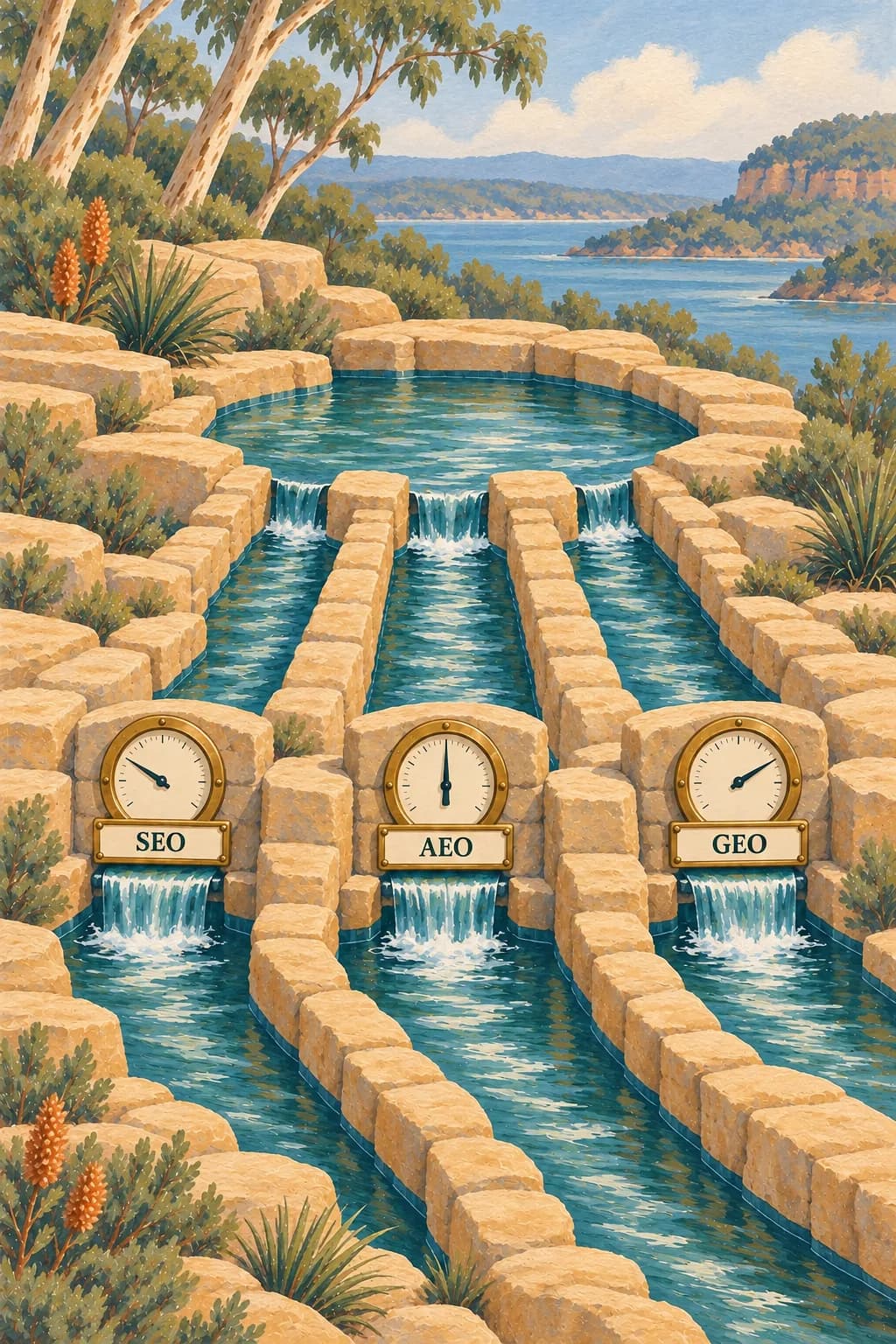
Think of one good page as a spring with three channels running out of it, one into search results, one into direct answers and one into AI answers. The water comes from the same place, which is why so much of the work overlaps. Each channel still needs its own gauge, so you check each result separately, as the picture shows.
The table puts the three side by side. Search Console is Google’s tool for seeing how your site appears in search. A click is a visit from a search result. An impression is each time a link to your site was shown. Read each row to see what one approach is for, then read the middle columns to see why the work overlaps. The fourth column shows where one approach checks something the others don’t.
Scroll across to read every column
| Approach | What the customer gets | Work it shares | What only this one checks | Where to look | What it can’t tell you |
|---|---|---|---|---|---|
| SEO | Finds and opens the right page from search results | Pages that search tools can reach, that are useful and accurate, with clear links between your own pages | Does the page answer the search? Has Google stored it for results? | Search Console clicks, impressions and stored-page status | Whether a visit became an enquiry |
| AEO | Gets a direct answer to one specific question | The same page, with the answer sitting next to the conditions that apply | Is the answer short and complete? | Saved screenshots of the answer boxes Google picks and its related-question boxes | Whether Google will pick your answer |
| GEO | Sees your business described or linked in an AI-written answer | The same page, plus project proof an answer can link to | Does the answer name you correctly and link a source that supports it? | Saved, dated AI answers and the reports Google and Bing publish | Whether a mention is a recommendation or a link is a sale |
Which jobs help SEO, GEO and AEO at the same time?
Most jobs help all three. One improved service page can make you easier to find, give a direct answer and give an AI tool a clear source to cite.
Scroll across to read every column
| One job | What it does for SEO | What it does for AEO | What it does for GEO |
|---|---|---|---|
| Rewrite a service page around a real customer question | Matches the words people search | Answers the question in the first sentences | Gives an AI answer a clear source to use |
| Add a finished project with its place and scope | Adds specific, original content | Backs up the answer with evidence | Gives the answer something concrete to name |
| Correct business details across listings | Keeps location and contact details consistent | Stops wrong details being quoted | Reduces mistakes in AI-written descriptions |
| Let search engines read the page | Makes the page available for search discovery | Makes the answer text available | Makes the page available to AI tools that look up web pages |
| Link related pages together | Helps search engines discover the pages | Helps a reader find the next answer | Helps AI tools follow related questions |
All of this depends on the tool you want to appear in being able to read your page. A program that reads web pages by itself is called a crawler. For Google’s AI features, a page must be stored for search, be allowed to show a quoted excerpt and be included in its Search generative AI features.1 Being stored for search is called being indexed. Other platforms have their own access rules, which the next section lists.
Kavera note: Our published SEO plans put SEO and AI-search work in one monthly scope. They do not list GEO and AEO as separate line items.
Do Google, ChatGPT, Perplexity and Microsoft work the same way?
No. Each one publishes its own access rules, which cover what you can control and what it shows. Each platform’s controls are independent, so check the relevant provider’s instructions. An answer format on one platform may not exist on another.
Three terms in the table. AI Overviews are the AI summaries Google shows in search. AI Mode is Google’s chat-style AI search. The file called robots.txt sits on your website and tells automatic page readers what they may fetch.
Scroll across to read every column
| Where | What lets your page in | What is different |
|---|---|---|
| Google AI Overviews and AI Mode | Google must store the page for search, be allowed to quote an excerpt and include the site in its generative AI features1 | Check the setting Search Console actually applies to your site, including any choice inherited from a parent setting3 |
| Google’s answer box (a selected answer extract) | Google decides whether a page gives a useful answer. Publishers can’t put themselves forward5 | A nosnippet instruction on a page blocks text excerpts, including the ordinary preview text under a search result5 |
| ChatGPT search | OpenAI’s OAI-SearchBot supports search. GPTBot is a separate crawler that relates to training the AI model7 | Blocking OAI-SearchBot keeps a site out of search answers, though it can still appear as a plain link7 |
| Perplexity | PerplexityBot reads sites for search results and not for training the AI model8 | Its tool that fetches a page when a user asks generally ignores robots.txt8 |
| Microsoft Copilot and Bing summaries | Microsoft reports on these through the AI Performance public preview in Bing Webmaster Tools9 | It reports citations and not rankings9 |
Agencies still sell FAQ markup as an AEO tactic, so it deserves a mention. FAQ markup is code that labels questions and answers for search engines. Google stopped showing FAQ rich results, the expanded question lists under some listings, from 7 May 2026.6 Keep an FAQ on a page because customers ask the questions.
What should an Australian business fix first?
Fix the most basic problem first. Start at the top of the list below and stop at the first row that sounds like you.
Scroll across to read every column
| If this is true | Fix first | Type of work |
|---|---|---|
| Search engines cannot read or store the page for results | Check page access, pages that have moved to a new address and whether the page is stored for search | SEO |
| The page does not answer the customer’s question plainly | Put the answer in the first two sentences, with any conditions next to it | AEO |
| The page claims things it does not show | Add a real project, place, scope and your role | GEO and SEO |
| Directories or profiles show wrong details | Correct them at the source | SEO and GEO |
| Customers ask ChatGPT or Google’s AI and you never appear | Save dated answers, read the sources and fix the gap they reveal | GEO |
In our experience an Australian local business usually meets the first three rows before the last. Three priorities cover most owners:
- Fix the missing customer answer or the access problem.
- Choose a separate measure for each outcome you want.
- Compare agency deliverables and take out any work that is listed twice before you agree fees.
What did one Sydney client see in Google and in AI answers?
SHORE is a Sydney builder and a Kavera client. We recorded three different results for it.
In Google, SHORE’s appearances in searches that didn’t use its name rose from 1,204 to 9,492, about 7.9 times as many. In a Google AI Overview for “duplex bondi beach”, Google named SHORE’s SOL duplex and cited its project page. For ChatGPT we recorded this. In two checks about two months apart, our client SHORE went from absent to first in one Sydney builder shortlist.
The full captures are in our guides on what is GEO and ChatGPT SEO. The dates and the limits of each result are in the fine print further down.
Kavera note: We built SHORE’s website and run its SEO. Our work began on 21 July 2026. Website and profile changes ran together, so we can’t say which change caused which result. That’s why we keep the three results apart.
How do you check whether SEO, GEO and AEO are working?
Check each type with its own tool and keep enquiries as a separate number. Mixing them gives you a figure that sounds impressive and means little. One term in the table is a question list. That is a fixed set of questions your customers might ask an AI tool, asked the same way each time.
Scroll across to read every column
| Type | What to measure | Where to look | What it can’t show |
|---|---|---|---|
| SEO | Clicks and impressions | Search Console Performance report, including traffic from Google’s AI features2 | How much came from AI Overviews alone |
| AEO | Whether Google’s answer box or related-question box shows your page | Screenshots you take and date yourself | How often other people see it |
| GEO on Google | Impressions in AI Overviews and AI Mode | Search Console Generative AI report4 | Clicks or enquiries |
| GEO on Microsoft | Citations and cited pages | Bing Webmaster Tools AI Performance9 | Rank, authority or role in an answer |
| GEO elsewhere | What the answer says and which sources it links | Your saved answers to a fixed question list | The experience of every searcher |
| All three | Enquiries and where customers say they heard of you | Your forms, calls and a direct question | Which search or AI tool sent them |
Google’s Generative AI report counts impressions, meaning how often links to your site were shown. It only appears once a site has enough of them.4 Microsoft says its citation counts show how often pages were cited and not how important they are or where they sat in an answer.9
Work out where your own enquiries come from before you plan a budget around anyone else’s conversion figures, meaning how often visitors complete an action such as a call or a form.
Our 50-question method from the Sydney trades study is one way to build a question list. The AI SEO guide describes the first month’s checks.
How do you avoid paying an agency twice for the same job?
Ask for the deliverables and the measures, then check whether any item is billed under two names. A page rewrite is a page rewrite whether the proposal calls it SEO, AEO or GEO.
Use these six questions on any proposal, including a quote like the Parramatta one above:
- Which pages will change and what will each change contain?
- Which customer questions will be tracked and who chooses them?
- How will answers be saved, dated and compared?
- Which report shows each result and what does it exclude?
- Is any task listed under more than one acronym?
- What is the price, the minimum term and how can you end the agreement?
Google says to judge third-party AEO and GEO advice against its own guidance.1 Be wary of offers that sell special AI markup, which is extra code on the page. Also be wary of an llms.txt file (a proposed file meant to guide AI tools) or a visibility score with no stated question set. Google says no special AI markup is needed and that its Search does not use llms.txt.1
No agency can guarantee a citation, a ranking or an enquiry. Ask to see dated answers, how many answers were tested and the checks that failed. A record that includes failures is easier to believe.
What is the fine print behind the numbers on this page?
The order of fixes in the priority table is our judgement from the work we do. It is not a tested rule.
The three SHORE results are separate observations, each with its own limit. A change in one does not predict a change in another.
Scroll across to read every column
| Observation | What was recorded | Limit |
|---|---|---|
| Google non-brand appearances | SHORE’s rose from 1,204 to 9,492, about 7.9x, between two four-week windows (22 June to 19 July and 4 September to 1 October 2026) | Appearances across its website and Maps listing together, not clicks, enquiries or revenue |
| Google AI Overview | The Overview for “duplex bondi beach” named SHORE’s SOL duplex and cited its project page | One observed answer and not a stable rank |
| ChatGPT shortlist | In two checks about two months apart, our client SHORE went from absent to first in one Sydney builder shortlist | One repeated question, so no general ranking or timeframe |
What should you do next?
Pick one service page and the three questions your best customers ask before they buy. Then work through three steps:
- Check that search tools can reach the page, using the table of platform rules above.
- Rewrite the first two sentences so they answer the question plainly.
- Save today’s AI answers to those three questions so you have something to compare against later.
Our generative engine optimisation services can take that review through with you.
Our SEO audit is free. Implementation is separate unless retained. Compare the SEO packages for monthly scope and terms. No SEO package guarantees rankings, leads or revenue.
Good questions
Common questions Clear answers
What’s the difference between GEO, SEO and AEO?
SEO is the wide job of helping customers find your pages through search. AEO is about giving a direct answer to one specific question. GEO is about how AI-written answers describe your business or link to it. The three overlap heavily. One useful page with real evidence can serve all of them, so ask an agency what it will deliver and not which acronym it uses.
Does GEO replace SEO or should my business do both?
GEO doesn’t replace SEO. Google says improving your site for its generative AI features is still SEO and that those features build on its core ranking systems. Other platforms publish their own rules, so check each one separately. Treat GEO as a way to check and extend your SEO work and not as a separate project.
How can I optimise my website for AI answers as well as Google search?
Choose one service page that answers a real customer question. Put the answer first, then add the jobs you do, the areas you cover and proof from finished projects. Keep your business details the same everywhere and make sure search engines can read the page. Then save dated AI answers to the same question and check whether they describe the right business and link to useful sources.
Do the same content changes help with SEO, GEO and AEO?
Often, yes. A clear answer, real proof, accurate details and a page that search engines can read help with all three. Still check each result separately: search clicks, direct-answer boxes and the way AI answers describe you and what they link to. Google needs no special code for its AI features. Other platforms publish their own access rules.
How can I measure whether my GEO or AEO work is paying off?
Write your question list first and save dated answers so you can compare them later. Add Google’s Generative AI report in Search Console for impressions and Bing’s AI Performance report for Microsoft citations. Then count enquiries separately, because being shown in an answer is not a sale. Neither report shows you clicks or conversions, meaning completed actions such as a call or a form.
Which should an Australian small business prioritise first: SEO, GEO or AEO?
Start with the customer question your site doesn’t answer yet. Then check that the search product you care about can read the page. Fix any access problem before you expect the page to be used. After that, improve the answer and save dated results from each product you care about. One platform’s rules don’t tell you how another platform behaves.
Sources
- Optimizing your website for generative AI features on Google SearchGoogle Search Central. Accessed .
- AI features and your websiteGoogle Search Central. Accessed .
- Search generative AI controlGoogle Search Console Help. Accessed .
- Generative AI performance report (Search)Google Search Console Help. Accessed .
- Featured snippets and your websiteGoogle Search Central. Accessed .
- Search documentation updatesGoogle Search Central. Accessed .
- Overview of OpenAI CrawlersOpenAI. Accessed .
- Perplexity CrawlersPerplexity. Accessed .
- Introducing AI Performance in Bing Webmaster Tools Public PreviewMicrosoft Bing. Accessed .