

Website redesign
Website copywriting that helps people enquire
The quick answer
Website copywriting should help a visitor decide whether your service fits and understand the next step. Name the work, explain who it suits and answer practical questions before asking for an enquiry. Use real examples and accurate terms. Measure accepted enquiries separately from button clicks to learn whether a rewrite helps.
On this page
Key takeaways
- A service page should explain the offer before asking the visitor to describe their project.
- Front Row Beauty Bar's specialist selection and David Owen's telephone booking need different calls to action.
- Specific project facts are more useful than unsupported claims about being the best.
- A button click and a successfully received enquiry are different measurements.
Website copywriting starts with the questions a visitor brings to the page. Can this business do the work? Does it suit my situation? What do I need to do next? If those answers are missing, adding a more confident adjective to the headline will not supply them.
We plan content alongside custom website design in Australia. The examples below come from three sites we built: SHORE, Front Row Beauty Bar and David Owen. Each shows how a few specific words help a customer understand the service and take the right next step.
What should your website copy help a customer decide?
Give the reader enough information to assess the service and choose a suitable next step. That means being specific about the work, the customer and any condition that changes how an enquiry starts.
For a builder, the distinction might be construction from supplied plans versus an integrated design-and-build service. For a salon, it might be an appointment with one practitioner versus a collective where the client chooses an independent specialist. Those differences belong near the offer, not in a paragraph after the contact form.
Before writing, complete a short factual brief:
| Question | Information to collect | Where it belongs |
|---|---|---|
| What work do we do? | The service names customers use | Opening and service headings |
| Who does it suit? | Project type, location and relevant needs | Introduction and scope |
| What can we show? | Real work with permission and accurate context | Project or example sections |
| What affects the decision? | Prices, process or suitability conditions | Beside the relevant service |
| What happens next? | Call, consultation, booking or written enquiry | Button and supporting text |
Use information from the person delivering the service. A copywriter can organise the answer but cannot responsibly invent an appointment policy or an installation allowance. Mark missing details in the working brief and resolve them before the page goes live.
What can real Kavera website copy teach us?
The most useful words often explain a business distinction in a small space. These three examples address different points in a customer's decision.
SHORE explains the relationship between design and construction
SHORE's homepage introduces the business as an integrated design-and-build practice for premium residences across Sydney. The supporting text explains that the disciplines work within one practice. That tells a prospective client what kind of commission they are considering.1
The relevant copy decision is to name the service model. A reader who already has an architect may approach the project differently from someone looking for a team to handle both design and construction. The website gives them information to frame that conversation.
For your own service, find the distinction a prospect might otherwise miss. Write it in one direct sentence and put it near the opening. Avoid substituting a broad claim about excellence for the explanation of what you do.
Front Row explains who manages the appointment
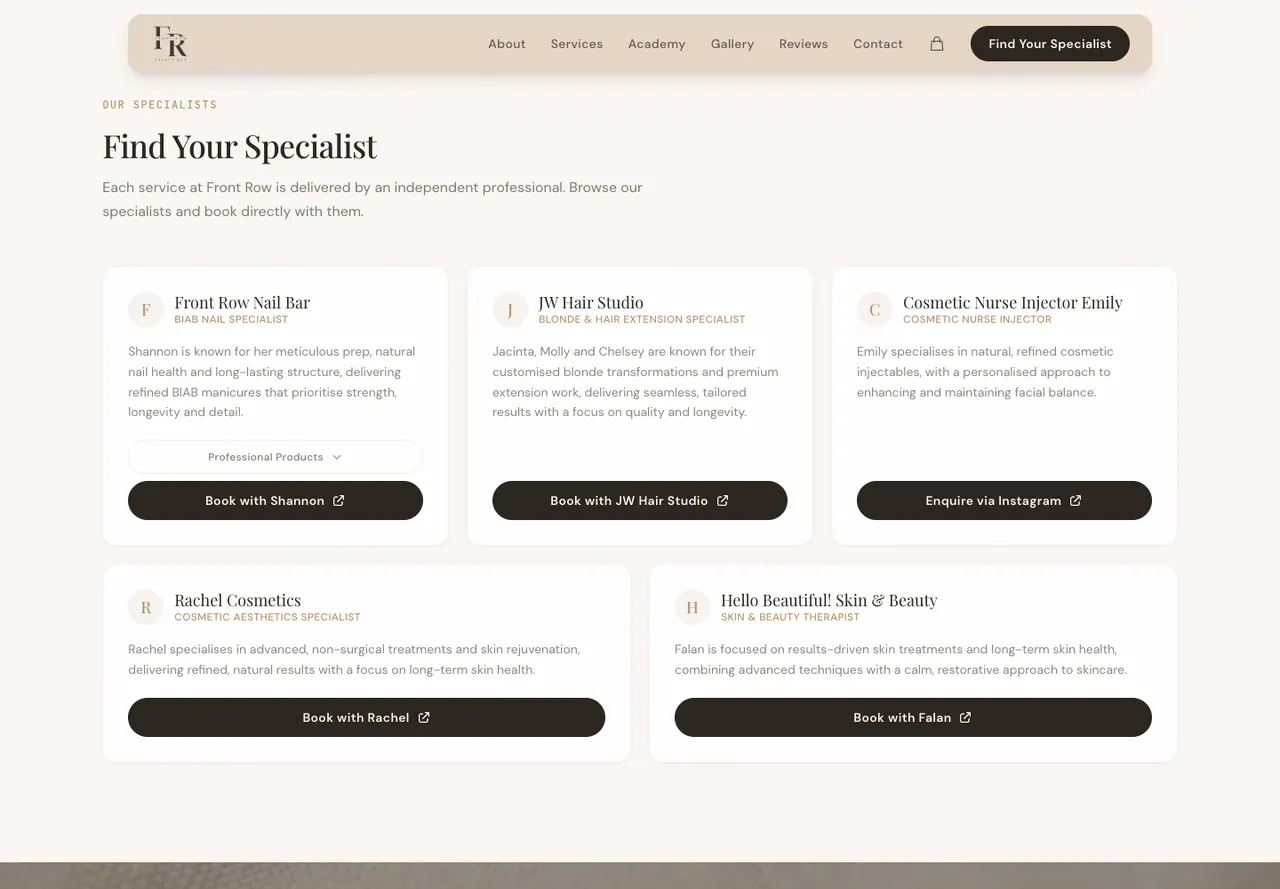
Front Row's page includes the line: “Each professional manages their own bookings and services.” Its specialist section then gives visitors a way to choose the relevant provider.2
A button such as “Choose your specialist” would make that next step clear. Use the same approach when visitors need to select a person or service before booking.
| Input or wording | Editorial decision | Reader benefit |
|---|---|---|
| Practitioners manage their own bookings | Keep that fact in the service introduction | Establishes who will handle the appointment |
| The opening action goes to the services section | Illustrative label: “Choose your specialist” | Describes the immediate destination |
| Each profile has its own contact route | Put the service and practitioner beside that route | Helps the client select the right business |
Our Front Row Beauty Bar case study shows how the specialist profiles and booking links work together.
That sentence changes the meaning of the booking journey. The client is choosing among independent businesses in a shared space. The website needs to explain that arrangement before sending them to an individual calendar.
Kavera note: On the live Front Row homepage, the opening appointment action leads to the services section. We used that section to help visitors choose a specialist before following a provider's booking link. The words and destination describe the same sequence.
The same principle applies outside salons. A consultancy with separate service teams or a venue with different event spaces should make the selection clear before asking the visitor to complete the wrong form.
David Owen gives a specialist service practical context
David Owen's site focuses on nanoplasty hair straightening. It presents the appointment process, prices by hair length and common questions. Its appointment buttons use telephone links.3
That route makes room for a conversation with the salon. The website can help the client arrive with more useful questions by explaining the service first. It should not imply that tapping the button reserves a time automatically.
For a phone-led service, a label such as “Call to discuss your appointment” helps the client know what to expect before tapping.
The builder examples and salon booking comparison show how those distinctions affect the rest of a page. For the delivered treatment-led site, see the David Owen case study.
How do you turn a vague paragraph into useful copy?
Replace broad praise with the facts a customer needs. These writing examples show how to turn a generic claim into something a customer can use.
| Vague draft | Clearer version | What changed |
|---|---|---|
| We deliver exceptional building solutions. | We build residential extensions from your building plans. | Names the work and the starting condition |
| Experience premium beauty services. | Choose your specialist, then book directly with their business. | Explains who the client will book with |
| Contact our expert team today. | Tell us the suburb and the work you are planning. | Gives the reader something useful to send |
| Flexible maintenance to support your growth. | The plan includes up to 30 minutes of minor website changes each month. | Replaces an abstract benefit with an allowance |
The final example uses an allowance published in Kavera's Website Care plan. It illustrates why commercial wording needs the exact scope. It would be misleading to turn that allowance into unlimited changes.5
Do not make every line sound like a specification. Once the necessary information is clear, the business can have a recognisable voice. A warm introduction or a distinctive sentence works best when the reader can still identify the service.
Read the paragraph with the business name removed. If it could describe almost any competitor, look for the missing fact. That might be the work type, the process or a useful constraint. Keep the fact when editing for length.
What belongs on a service page before the enquiry button?
Answer the questions that affect whether the visitor should contact you. The order should follow how people choose that service.
A straightforward service page can introduce the offer, describe what is included, show relevant work and explain how the enquiry begins. A more involved purchase may need pricing context and a process section before the reader is ready to contact the business.
Put qualifications beside the claim they change. If a price is a starting price, explain what affects it nearby. If the service is available only in certain areas, name them before the form. If a consultation is required, say so beside the appointment action.
Project stories should explain the business's role. A website project can show what was built and how a visitor moves through it. That alone does not establish a revenue result. Use measurable outcomes only when you have the source, the period and a clear definition of what was counted.
Keep the page's search topic clear through descriptive headings and natural service language. Writing the same keyword in every paragraph will not repair a missing answer. The Australian Government Style Manual recommends clear structure, common words and the most important information early in the content.4
How should a call to action be written?
Describe the action the visitor can take now. Then explain what follows if it is not obvious.
A project enquiry can ask someone to describe the work. A consultation action can say whether it opens a calendar or sends a request. A service comparison page may sensibly lead to pricing before it asks for contact.
Read button copy together with its destination. If a button says to view prices, it should lead to prices. If it starts a telephone call, make that contact method clear. Avoid using a booking label for a general message form without explaining that a person will arrange the appointment afterwards.
The form itself is part of the copy. Use labels that explain the information requested. Say which fields are optional. An error message should identify what needs correcting without blaming the person using the form.
After submission, tell the visitor what happened and what to expect. Do not promise a response time the business cannot maintain. Provide a usable contact alternative if the submission fails, then check the delivery system as well as the wording.
Can you improve copy without rebuilding the website?
Often you can begin with a focused change to the page people already visit. Fix an unclear service introduction, add a missing scope condition or repair an action label that does not match its destination.
Keep useful URLs and content when making the change. If the page already attracts relevant searches, those visitors still need a home for the question they came to answer. The website redesign checklist covers that continuity when the work grows into a larger rebuild.
Make one page's purpose clear before rewriting every section of the site. Repeated generic text across a group of service pages is usually a sign that the services have not been explained individually. Ask the business what changes between those jobs and use the answer to shape distinct content.
You can then brief custom website design in Australia around real content if the current layout prevents people finding it. A designer can make better decisions with a finished service explanation than with placeholder paragraphs of the expected length.
How do you measure whether the copy brings enquiries?
Track the enquiries your business receives and whether they concern work you want. Button clicks can help you spot interest, though the messages and calls themselves tell you more about customer needs.
Record the page, date and exact copy change. Compare equivalent complete periods and review what else changed, including advertising, pricing, seasonality or the form itself. If several things change together, the result belongs to the combined change until stronger evidence separates them.
Use the business's assessment of enquiry quality as well as the count. More messages about work you do not offer can be a sign that the page is less clear. Add the missing service boundary rather than celebrating the larger number alone.
For a low-traffic page, avoid treating a few enquiries as a reliable experiment. Review the wording with real prospective customers, check the route to contact and allow enough time to collect useful evidence.
Start with one service page. Gather its real scope, choose the next action and write the questions a suitable customer needs answered. That gives you a concrete copy brief and a clear change to evaluate.
Common questions
What is website copywriting?
Website copywriting is the work of planning and writing the words people use to understand a website's offer and take the next step. It includes headings, service descriptions, project stories, button labels and form messages. For a service business, the copy should help a visitor judge suitability and make an informed enquiry.
How much copy should a service page have?
Write enough to answer the questions a suitable customer needs before contacting you. A straightforward service may need little explanation. A complex project may need process, scope, examples and practical qualifications. Edit repeated points before cutting useful detail. There is no word count that guarantees a better page or more enquiries.
Should I write website copy before the design?
Plan the main message, service structure and customer questions before finalising the design. You can refine wording alongside the layout but the designer needs real content to judge hierarchy and spacing. A placeholder heading cannot reveal whether the offer is clear or whether an important condition will fit beside its call to action.
Can AI help write my website copy?
AI can help organise supplied information and suggest drafts but a person who knows the business should check every claim. Give it accurate service details, real examples and the intended next step. Remove invented credentials, prices and results. Read the draft against the source material and test whether it sounds like your business.
How do I know whether new website copy works?
Choose a clear outcome before making the change, such as relevant enquiries received through a service page. Track the page visits and enquiry events for a defined period, then assess enquiry quality with the business. Record other changes such as advertising or pricing. A small sample or several simultaneous changes cannot isolate the effect of the copy.
Sources
- SHORE homepage and integrated design-and-build introductionSHORE. Accessed .
- Front Row Beauty Bar specialist selection and appointment linksFront Row Beauty Bar. Accessed .
- David Owen treatment information and telephone bookingDavid Owen. Accessed .
- Quick guide to plain languageAustralian Government Style Manual. Accessed .
- Website package content support and scopeKavera Digital. Accessed .

Arthur Syrios
About ArthurLet’s talk.
Tell us what your business needs and we will point you to the right option.
Custom website design in Australia