
Support pages
Each support page covers what the support involves, who it suits and how to ask about it.

NDIS websites · Australian providers
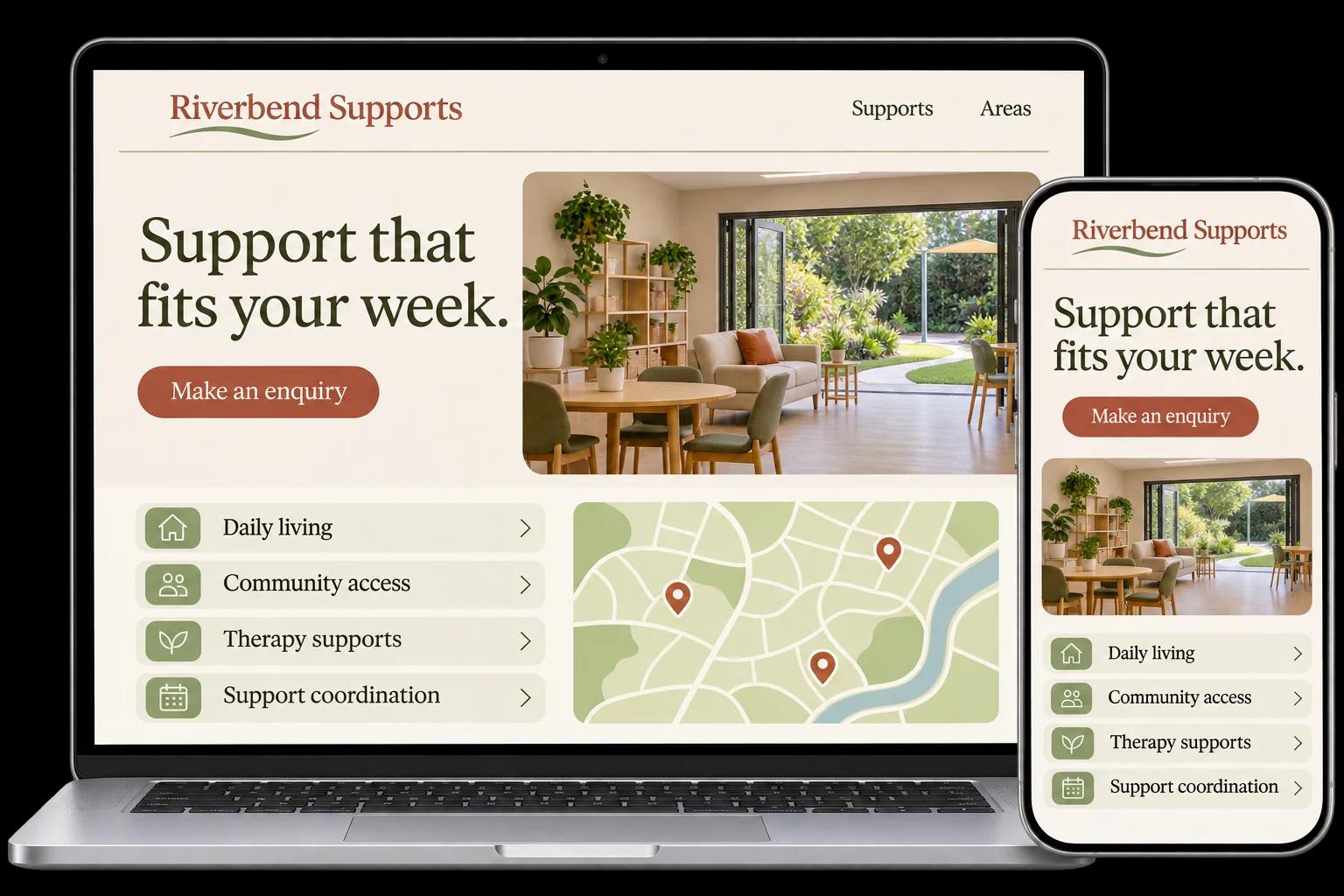
NDIS website design is about making three things easy to find: the supports you offer, the areas you cover and how to get in touch. We build websites for Australian providers of disability supports with clear pages for your main supports, plain wording and an easy way to enquire.
Page content is included in every website package and we write it. Your registration details come from your own certificate or register entry.
NDIS providers
A website for participants, families and support coordinators should show whether you have room for someone new and how to reach you.
A provider with several supports or service areas needs a site that keeps each one easy to find. Giving each support its own page and listing the areas you cover in one place lets a family check the fit without phoning first. Plain wording, clear headings and labelled form fields keep the whole visit simple.
Registration needs the most care on an NDIS website. Only a registered provider may advertise as one.
NDIS essentials
Every part of the site should make it easier for a participant or family to understand your supports and ask about them.
Each support page covers what the support involves, who it suits and how to ask about it.
The suburbs or regions you cover are listed in one place, with a plain line on whether you have room for new participants.
The Australian Human Rights Commission points organisations to measures such as clear links and section headings. Pages use plain wording throughout and every button and form field works.
For organisations, the Australian Human Rights Commission recommends conforming with the Web Content Accessibility Guidelines (WCAG) 2.2 at a minimum of Level AA. Agree your website's accessibility target with us in the project scope.
We match each page to your real registration status. A registered provider can link to its listing in the NDIS Provider Register, where anyone can search for registered providers. An unregistered provider's pages say so plainly.
The enquiry form is simple and its fields are labelled. Your phone number and email address are shown clearly and your complaints details are just as easy to find.
Package fit
The right scope depends on the number of supports you deliver and the places you deliver them.
$600 + GST once-off
$1,500 + GST once-off
$2,500 + GST once-off
$4,000 to $9,000 + GST
Keep exploring
Our SEO plans for NDIS providers, from Suburb SEO at $890/month + GST.
Explore SEO for NDIS providersHow to name the work, say who it suits and cover the practical questions a visitor has before they enquire.
Read the guideCompare every package, with prices and page allowances.
See website pricingGood questions
A good NDIS website helps a participant or family see what you offer, where you work and who to contact. It gives each support a page, lists the areas you cover, uses plain wording and offers an easy way to enquire. It also says plainly whether you are taking on new participants.
The entry option is the one-page Launch Website at $600 + GST once-off. Moving up, Launch Plus allows up to five pages at $1,500 + GST once-off and Launch Pro up to ten at $2,500 + GST once-off. A Business Website of up to 15 pages is $4,000 to $9,000 + GST. The Premium CMS Website is $9,000 to $14,000 + GST and the Signature Editorial Website starts from $15,000 + GST. First-year hosting is free, then Managed Hosting is $199/year + GST. Domain registration is separate.
Build time starts at one week for a Launch Website and adds a week with each package above it, so Launch Plus takes two, Launch Pro takes three and a Business Website takes four. The clock runs from agreed scope and assumes you supply all the information we need within 48 hours, such as your logo, images and service details. Premium CMS and Signature Editorial builds are scoped individually.
A business can describe itself as a registered provider only when it is registered with the NDIS Commission. One that is not registered must not pass itself off as one. The NDIS Commission requires registration for some supports and other providers can choose whether to register. An unregistered provider's pages should say plainly that it is not registered.
The primary NDIS logo needs written consent from the National Disability Insurance Agency (NDIA), including on advertising. The "I/we heart NDIS" and "I/we support NDIS" logos are different: only registered NDIS providers may use them with the tagline "Registered Provider". A website should never suggest a link with the NDIA or the NDIS that does not exist.
Not in a way that promises cover. The NDIS logo guidelines say it is not correct to state or imply that particular goods or services will in all cases be covered by the NDIS. They also advise against statements such as "NDIS approved" or "100% NDIS funded". Describe what each support involves and who it suits. Avoid wording that guarantees funding. You can say which plan types can use you: self-managed and plan-managed participants can use unregistered providers for supports that do not require registration, while NDIA-managed supports require a registered provider.
Version 2.2 of the Web Content Accessibility Guidelines (WCAG) at Level AA is the minimum the Australian Human Rights Commission recommends for organisations. Its guidance also explains that the Disability Discrimination Act requires providers of goods and services not to discriminate against people with disability.
Tell us which supports you offer, where you work and how people reach you today.